skip to Main Content

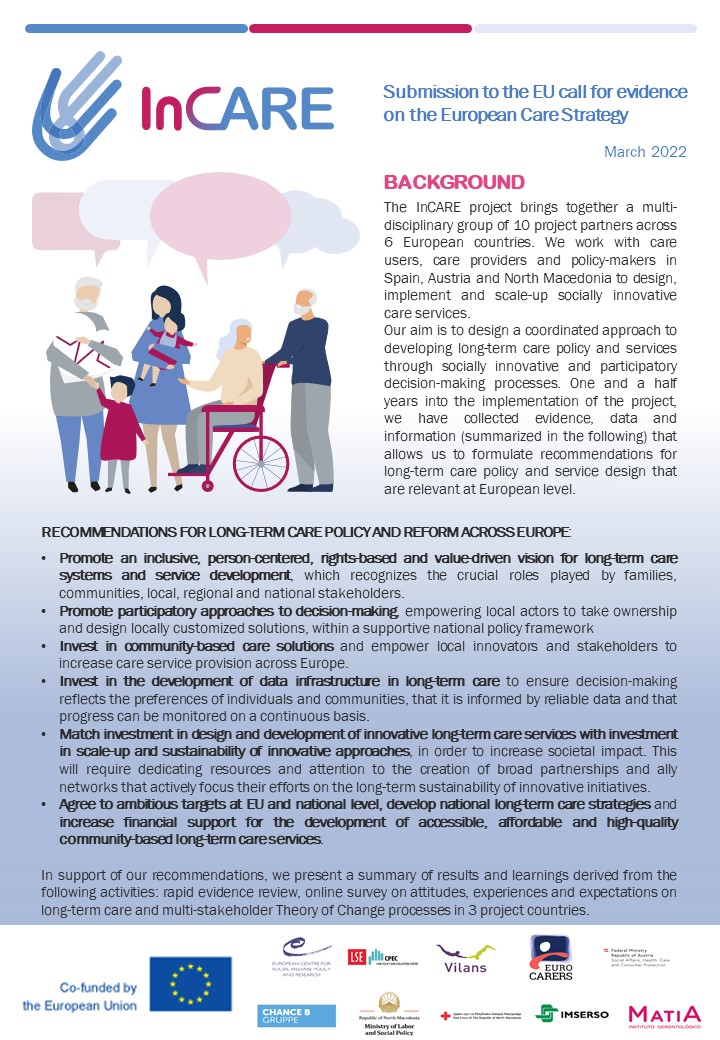
The InCARE project will contribute to the design  of a coherent and coordinated approach to the development of national long-term care policy and care services at local and regional level, by establishing socially innovative and participatory decision-making processes.

We work with care users, care provider organizations and policy-makers in Spain, Austria and North Macedonia to design, implement and scale-up innovative care services, with the ultimate goal of improving the well-being of older people and their families and increase their access to adequate and affordable care.
[Translated] I care for my husband after a stroke and brain hemorrhage, which means he needs me around the clock. I would like to have a paid time off of one week once a year and my husband is well taken care of and does not feel “deported”. After all, by taking care of him, I save the state a lot of money!

Woman, 72
Austria
[Translated] In the next few years, Germany will need more good care facilities, if possible connected with other living facilities in which partners can also live. With high quality standards, but also with empathetic nursing and care staff and good living standards. With medical care, physiotherapy and a good activation program. Care should be affordable for all and not be passed on to family members who risk their health, private life and income for it. Nursing home care should not be stigmatized, as it relieves relatives of a great deal of work and ensures care free interaction with the persons to be cared for. Financial reasons should not be the reason why people do not go to a nursing home, because the psychological burden is too high.

Woman, 66
Germany

Thank you for dealing with this study as it will help many people.

Woman, 47

The government should invest in training social workers, so that quality of care is as high as possible, and at the same time the social status of social workers, professional carers and nursing staff is raised, they are better paid, and young persons would like to choose such careers.

Woman, 69
Poland

“Given the current state of care facilities, I would prefer to take care of my parents/loved ones at home and if I should require services I would prefer to be taken care of at home. The way I view care facilities in their present state is that these facilities provide everything needed to keep a person alive but greatly reduce their quality of life (e.g., loss of dignity, reduced access to meaningful activities and social interaction, loss of agency etc.). I believe it is practical, feasible and in governing bodies best interest in the long term to improve quality of care in these facilities. We now have good evidence for activities/programs that can improve wellbeing and physical health in older adults. We should be utilizing this evidence to improve the lives of older adults. If the quality of care provided in these facilities drastically improves, I would view this as the preferred option. But we are not there yet.”

Woman, 31
Canada
[translated] In general, the state should take care of the financing of care services and introduce a system for quick access to emergency medical care.

Woman, 72
North Macedonia

I visit my stepmother who is in a wheelchair after a severe stroke 14 years ago. She can cope with the costs of care so I can see the restrictions she faces even when there is sufficient money. She is physically but not mentally disabled. She is unable to use a smart phone or an I-pad and needs 24 [hour] help. She cannot use even disabled toilets. Access into taxis is difficult and impossible in a private car.

Woman, 74
United Kingdom

I have Parkinson’s Disease and I dread what the future holds for me physically and mentally.

Woman, 75
Ireland

“It’s very difficult to take care of elderly. It causes a lot of stress with effects on health. Wished for some more support structures. Needs have to be assessed often as they can change frequently.”

Woman, 49
Malta
[translated] Long-term care should be almost exclusively the prerogative of state institutions that should have the necessary infrastructure and resources to respond to the needs of older people and their families.

Man, 47
Romania
Back To Top
Translate »