skip to Main Content

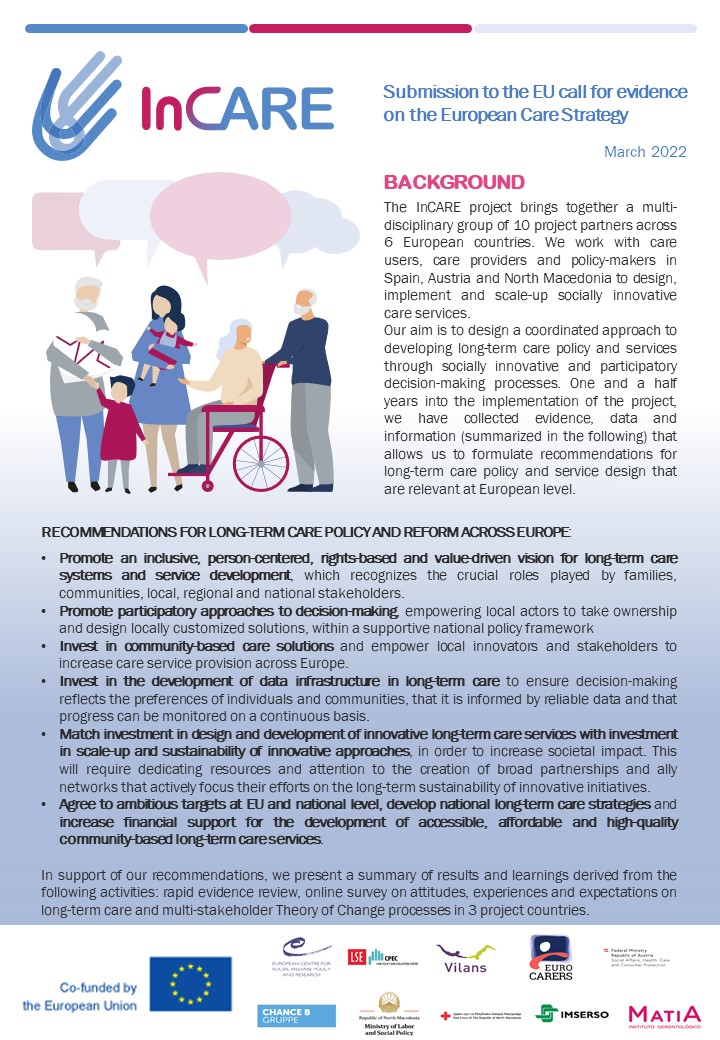
The InCARE project will contribute to the design  of a coherent and coordinated approach to the development of national long-term care policy and care services at local and regional level, by establishing socially innovative and participatory decision-making processes.

We work with care users, care provider organizations and policy-makers in Spain, Austria and North Macedonia to design, implement and scale-up innovative care services, with the ultimate goal of improving the well-being of older people and their families and increase their access to adequate and affordable care.
[Translated] It is complicated to get help when the parent who needs it is living abroad (France) and it is impossible for him/her to live alone. Because no retirement home can be found for him/her, the only solution is to take him/her at home (in another country of the European Union)

Woman, 63
Belgium
[translated] This issue [of long-term care] needs to be discussed and prioritised by the state, because the population is ageing, children are going abroad and local structures for [supporting older people] need to be improved and a concrete annual budget established. We will all reach an age when we need help.

Woman, 43
Republic of Moldova
[Translated] I would not want my future to be in the hands of politicians but in the hands of qualified experts.

Man
Spain

Both my parents died in a nursing home. I believe that had there been appropriate in-home care available outside of the hours of 9am to 5pm that my mother might have been able to live at home. As it was she suffered a severe fall at night and was admitted to hospital and declined there to the point that she required full-time care. The cost of overnight carers was exorbitantly expensive. The government should put more resources into providing high quality home care which doesn’t end at 5pm when patients are most vulnerable

Woman, 44
Ireland
[Translated] It would be good if the decisions were also upheld when the care allowance is raised. Often the decision ends up in court and it is possible to challenge it. It should not be made difficult for those who are dependent on this financial support.

Woman, 36
Austria
[translated] These studies are interesting, but [I do not know] whether the obtained results will have an impact or be used by the competent institutions, in the direction of improving the situation with provision of care to the elderly… We have low incomes and therefore we do not have the opportunity to resign or pay for caregiver or nursing home services… nor do our parents have such pensions that can cover their expenses to stay in a nursing home, where they will live comfortably and be treated with dignity …

Woman, 53
North Macedonia
[…] When Covid came along it destroyed very important connections that enable older people in nursing homes to keep going & stay connected, to keep hope alive – the deterioration in my Mother in just 18 months was, & still is, devastating & resulted in her recent death. All those months we were unable to be by her side & keep her going, instead she wasted away as she was unable to comprehend what was going on with Covid, yet she was aware enough to know we were no longer with her. Looking through a window trying to communicate love & care to someone with dementia & who is very confused about why you wouldn’t come inside was one of the cruelest experiences. It was terrible to witness just how much our older people are let down by lack of creative, adequate, & in my opinion humane, care options because even in times of desperation when I considered taking my Mother out of the nursing home to live with me the pain of knowing that was not possible was very heavy as I knew the reality of what it had been like 4 years previously trying to care for her – lack of adequate home help, lack of adequate services – & now along now with significantly increased care needs it would have been a recipe for crisis. I became very unwell physically when I’d been involved in her care prior to her going to live in the nursing home.”

Woman, 46
Ireland
[translated -excerpt, emphasis in original text] Home-based assistance offered by the Romanian state to older people DOES NOT EXIST. This is unacceptable. […] for sick people and the elderly the situation is extremely BAD. There is no help. No state funded services to help them at home or in an institution, facilities for the elderly are so bad they are more like prisons or labour camps. I also strongly advise you to do a study and personal visits to psychiatric hospitals, and how mental health is treated in Romania.

Woman, 39
Romania
[translated] The development of home care services in Romania would contribute to increasing the quality of life of Romanians and would be of great help to family doctors [general practitioners] who are overburdened with time-consuming bureaucratic tasks.

Woman, 60
Romania
[translated] Additional taxation for end-of-life care is not equitable, considering that people already pay for health insurance. It would be necessary to eliminate corruption in the national health system, increase the quality of services and put a stop to the capture of the national health system by private entities who misappropriate funds that should be invested in our health, turning them into personal profit.

Woman, 37
Romania
Back To Top
Translate »