skip to Main Content

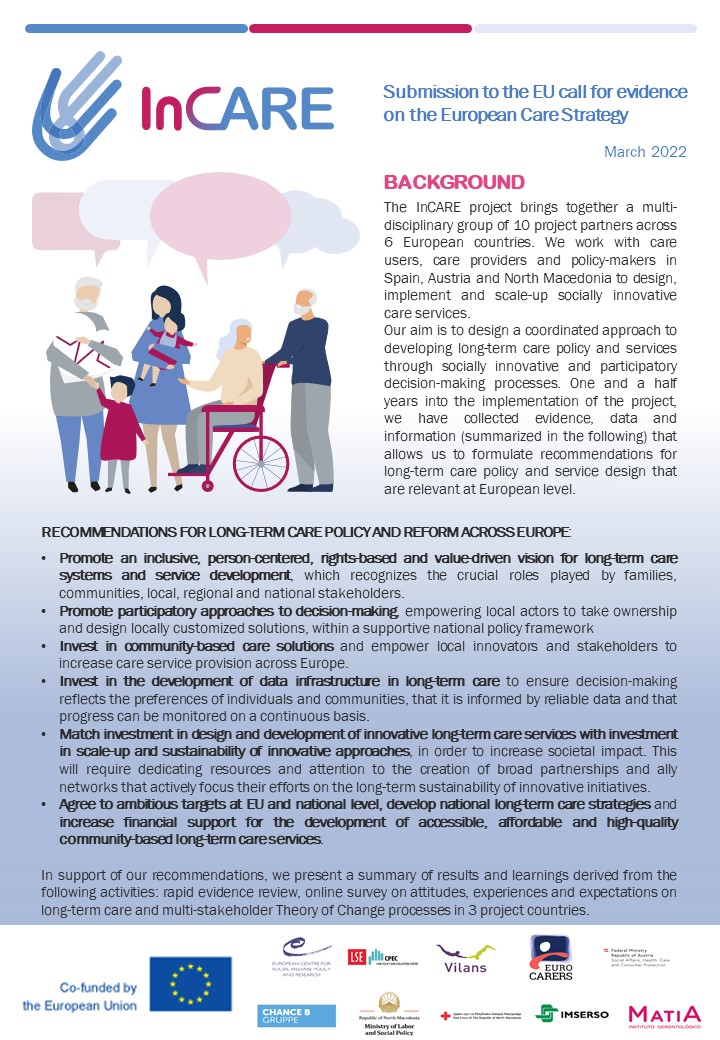
The InCARE project will contribute to the design  of a coherent and coordinated approach to the development of national long-term care policy and care services at local and regional level, by establishing socially innovative and participatory decision-making processes.

We work with care users, care provider organizations and policy-makers in Spain, Austria and North Macedonia to design, implement and scale-up innovative care services, with the ultimate goal of improving the well-being of older people and their families and increase their access to adequate and affordable care.
[translated] These studies are interesting, but [I do not know] whether the obtained results will have an impact or be used by the competent institutions, in the direction of improving the situation with provision of care to the elderly… We have low incomes and therefore we do not have the opportunity to resign or pay for caregiver or nursing home services… nor do our parents have such pensions that can cover their expenses to stay in a nursing home, where they will live comfortably and be treated with dignity …

Woman, 53
North Macedonia
[Translated] I care for my husband after a stroke and brain hemorrhage, which means he needs me around the clock. I would like to have a paid time off of one week once a year and my husband is well taken care of and does not feel “deported”. After all, by taking care of him, I save the state a lot of money!

Woman, 72
Austria
[Translated] Children and partners should never be forced to take care of their relatives. Everyone wants to be able to live their life the way they want. It’s great that a survey like this is being done. Thank you!

Woman, 67
Austria

I have Parkinson’s Disease and I dread what the future holds for me physically and mentally.

Woman, 75
Ireland

Every person in need of care must be cared for so that he or she has all the dignity required. Taking into account their limitations, they must be provided with the highest possible quality of life. This care must be provided by family members and professional staff so that their affective and assistance needs are covered.

Woman, 64
Spain
[Translated] I am not happy with the current nursing home system and it is a system that is focused on services and not on people. It is desirable that this changes with everyone’s help.

Woman, 41
Spain
[Translated] In the next few years, Germany will need more good care facilities, if possible connected with other living facilities in which partners can also live. With high quality standards, but also with empathetic nursing and care staff and good living standards. With medical care, physiotherapy and a good activation program. Care should be affordable for all and not be passed on to family members who risk their health, private life and income for it. Nursing home care should not be stigmatized, as it relieves relatives of a great deal of work and ensures care free interaction with the persons to be cared for. Financial reasons should not be the reason why people do not go to a nursing home, because the psychological burden is too high.

Woman, 66
Germany
[translated] Centers for socializing of the elderly should be provided, for playing chess, knitting, and so on; because after they retire they are at home all day and have no communication with other people.

Man, 36
North Macedonia
[translated] Let’s not abandon the elderly, they do not deserve that.

Woman, 61
North Macedonia
[Translated] In Belgium, we are immensely lucky that our health care system is based on solidarity. It is important that this continues and is even strengthened to avoid inequalities.

Woman, no age specified
Belgium
Back To Top
Translate »