skip to Main Content

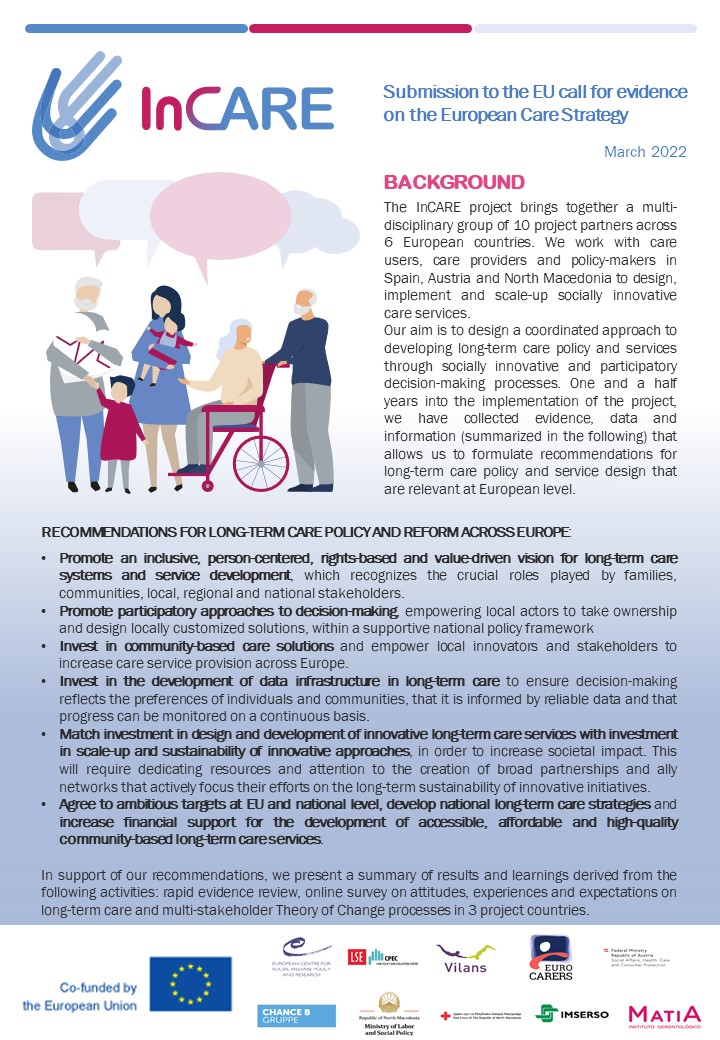
The InCARE project will contribute to the design  of a coherent and coordinated approach to the development of national long-term care policy and care services at local and regional level, by establishing socially innovative and participatory decision-making processes.

We work with care users, care provider organizations and policy-makers in Spain, Austria and North Macedonia to design, implement and scale-up innovative care services, with the ultimate goal of improving the well-being of older people and their families and increase their access to adequate and affordable care.
[translated] These studies are interesting, but [I do not know] whether the obtained results will have an impact or be used by the competent institutions, in the direction of improving the situation with provision of care to the elderly… We have low incomes and therefore we do not have the opportunity to resign or pay for caregiver or nursing home services… nor do our parents have such pensions that can cover their expenses to stay in a nursing home, where they will live comfortably and be treated with dignity …

Woman, 53
North Macedonia
[Translated] There are now already too few caregivers and nothing is done about it! How will that be in 10 years ?!

[No gender specified], 68
Austria

Thanks for keeping this in the public eye. No easy answers, I’m not sure I agree with all of mine today, but we must keep trying!!

Man
United Kingdom
[Translated] Support and training for family caregivers is needed in many ways.

Woman, 66
Austria

Both my parents died in a nursing home. I believe that had there been appropriate in-home care available outside of the hours of 9am to 5pm that my mother might have been able to live at home. As it was she suffered a severe fall at night and was admitted to hospital and declined there to the point that she required full-time care. The cost of overnight carers was exorbitantly expensive. The government should put more resources into providing high quality home care which doesn’t end at 5pm when patients are most vulnerable

Woman, 44
Ireland
[Translated] It would be good if the decisions were also upheld when the care allowance is raised. Often the decision ends up in court and it is possible to challenge it. It should not be made difficult for those who are dependent on this financial support.

Woman, 36
Austria
[Translated] I lost my father last year (cancer). We kept him at home, with my brothers and sister, almost until the end; we are now looking after our mother. She has been in a nursing home for several months. We take turns every day to get her up, wash her, dress her, feed her and take her out. The staff at the care home is always on leave, there is a high turnover of staff. Not only does my mother pay, we each pay a small part of the accommodation, but we are the ones who take care of her from morning to night. That’s why we are part-time.

Woman, 55
France

Thank you for dealing with this study as it will help many people.

Woman, 47
[translated] In general, the state should take care of the financing of care services and introduce a system for quick access to emergency medical care.

Woman, 72
North Macedonia
[Translated] None of the services I have used have the means to help dependent people with multiple sclerosis. It’s a horror. I have to do everything on my own because the home carers for example can’t come if I’m in hospital or on rehabilitation…the domestic helpers are no longer available, I am not entitled to a transport service … I never qualify. I am revolted. I live alone without family and it’s really hard. I’ve been able to get help at times but it doesn’t last because the budgets are so small. Even people with severe physical disabilities don’t have adequate help. The Aviq [Agence pour une Vie de Qualité] has not been functioning for years… the situation is very serious. And it has become even worse with Covid.

Woman, 40
Belgium
Back To Top
Translate »