skip to Main Content

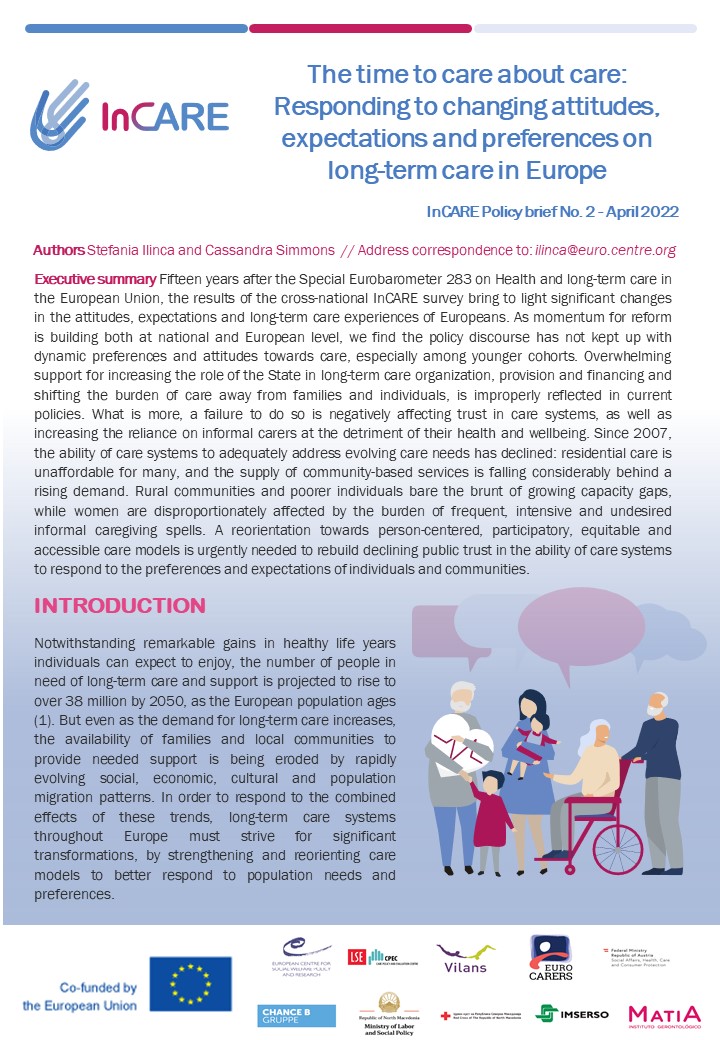
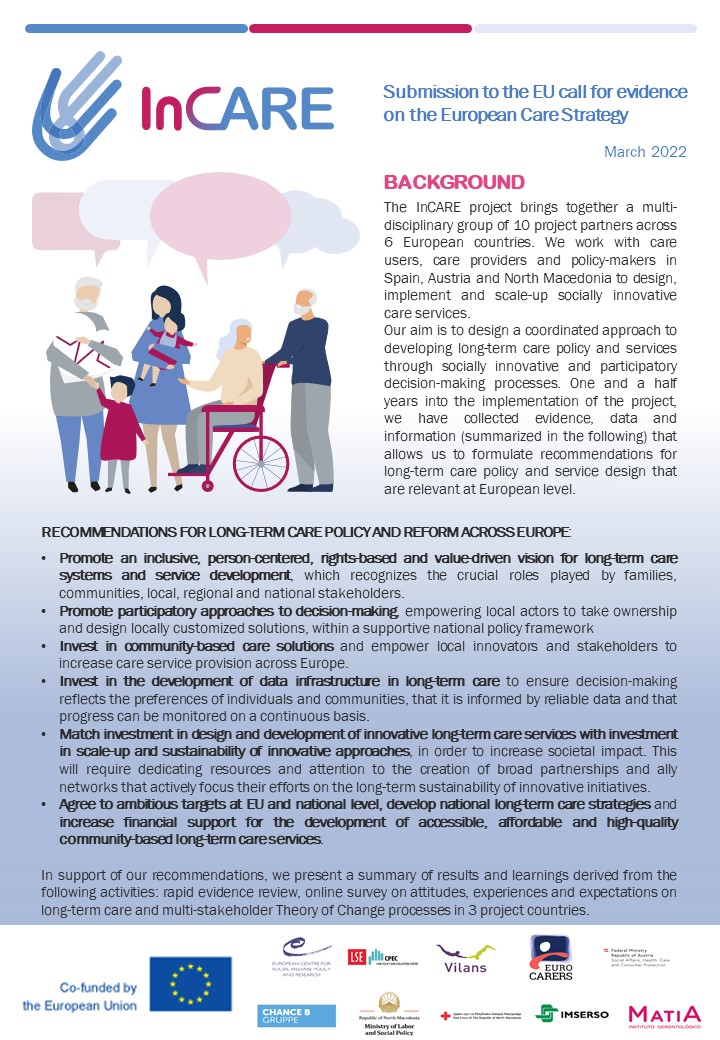
The InCARE project will contribute to the design  of a coherent and coordinated approach to the development of national long-term care policy and care services at local and regional level, by establishing socially innovative and participatory decision-making processes.

We work with care users, care provider organizations and policy-makers in Spain, Austria and North Macedonia to design, implement and scale-up innovative care services, with the ultimate goal of improving the well-being of older people and their families and increase their access to adequate and affordable care.
[Translated] I would not want my future to be in the hands of politicians but in the hands of qualified experts.

Man
Spain

The government should invest in training social workers, so that quality of care is as high as possible, and at the same time the social status of social workers, professional carers and nursing staff is raised, they are better paid, and young persons would like to choose such careers.

Woman, 69
Poland
[translated] This issue [of long-term care] needs to be discussed and prioritised by the state, because the population is ageing, children are going abroad and local structures for [supporting older people] need to be improved and a concrete annual budget established. We will all reach an age when we need help.

Woman, 43
Republic of Moldova

I visit my stepmother who is in a wheelchair after a severe stroke 14 years ago. She can cope with the costs of care so I can see the restrictions she faces even when there is sufficient money. She is physically but not mentally disabled. She is unable to use a smart phone or an I-pad and needs 24 [hour] help. She cannot use even disabled toilets. Access into taxis is difficult and impossible in a private car.

Woman, 74
United Kingdom
[translated] My biggest fear is that I will be powerless to support and provide for myself. That would place my family in a difficult financial and physical situation, given that my future salary and pension will not be enough to cover all expenses.

Woman, 45
Republic of Moldova

Thank you for dealing with this study as it will help many people.

Woman, 47
[translated] Well, I hope that caregivers get a protected or priority status – I mean at work and as workers, everyone needs us, our attention, and to some extent it feels like we are omnipotent and can care for others, care for ourselves and sometimes, care for our parents. That is wrong.

Man, age not specified
North Macedonia
[Translated – excerpt] Long-term care is an obligation of society. The administration has to participate and set criteria for equality, but it has to get involved in management, if it wants to do so under the same conditions as everyone else. Give a choice to the citizen who chooses what he/she wants, not what the administration thinks (free choice). Care should be directed by the people, not only centred on them. Empowerment of the citizen. Promote professional training and above all competences and skills. Increase staff ratios and salaries, and above all work/family/leisure balance. There is a lot of work to be done.

Man, 55
Spain
[translated] It is not easy to gain the trust of a stranger and let them take care of you. Trust and safety are also very important factors in receiving /providing long-term care.

Woman, 45
North Macedonia
[Translated] It would be good if the decisions were also upheld when the care allowance is raised. Often the decision ends up in court and it is possible to challenge it. It should not be made difficult for those who are dependent on this financial support.

Woman, 36
Austria
Back To Top
Translate »