skip to Main Content

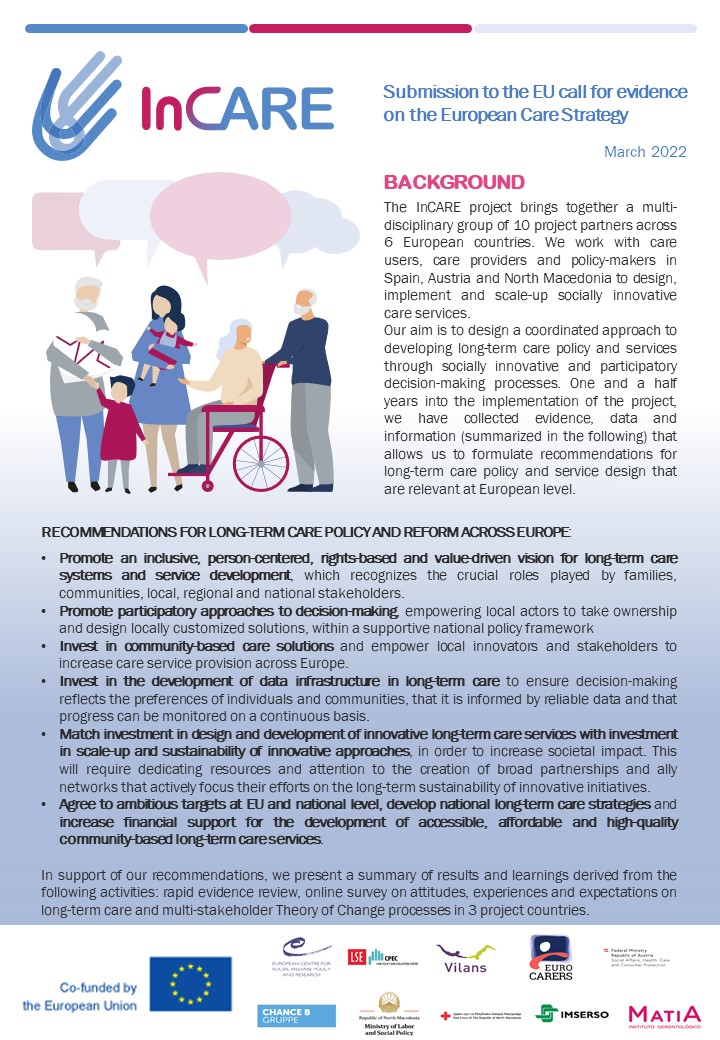
The InCARE project will contribute to the design  of a coherent and coordinated approach to the development of national long-term care policy and care services at local and regional level, by establishing socially innovative and participatory decision-making processes.

We work with care users, care provider organizations and policy-makers in Spain, Austria and North Macedonia to design, implement and scale-up innovative care services, with the ultimate goal of improving the well-being of older people and their families and increase their access to adequate and affordable care.
Start to talk openly [about] discrimination of elderly in Sweden which has been going on AT least 20 years by now [emphasis in original].

Woman, 52
Sweden

For the past ten years, I have been providing care to my mother with dementia and complex care needs whilst at the same time raising two children alone following the break-up of my marriage due to domestic abuse, and trying to combine this with work. I am exhausted and feel completely burnt out. Caring has negatively impacted on my work and career and affected my family life. My mother has recently moved to a small scale nursing home where she is so happy and so well looked after. There is huge pressure on families to continue to look after people with highly complex care needs and I question that. There are too few small scale nursing homes in Ireland.

Woman, 55
Ireland
[Translated] I don’t understand why people with high income and property don’t have to pay for their own place in [residential] care homes!

Woman, 74
Austria

“It’s very difficult to take care of elderly. It causes a lot of stress with effects on health. Wished for some more support structures. Needs have to be assessed often as they can change frequently.”

Woman, 49
Malta
[Translated] None of the services I have used have the means to help dependent people with multiple sclerosis. It’s a horror. I have to do everything on my own because the home carers for example can’t come if I’m in hospital or on rehabilitation…the domestic helpers are no longer available, I am not entitled to a transport service … I never qualify. I am revolted. I live alone without family and it’s really hard. I’ve been able to get help at times but it doesn’t last because the budgets are so small. Even people with severe physical disabilities don’t have adequate help. The Aviq [Agence pour une Vie de Qualité] has not been functioning for years… the situation is very serious. And it has become even worse with Covid.

Woman, 40
Belgium
[Translated] In Belgium, we are immensely lucky that our health care system is based on solidarity. It is important that this continues and is even strengthened to avoid inequalities.

Woman, no age specified
Belgium

The government should invest in training social workers, so that quality of care is as high as possible, and at the same time the social status of social workers, professional carers and nursing staff is raised, they are better paid, and young persons would like to choose such careers.

Woman, 69
Poland
[Translated] I care for my husband after a stroke and brain hemorrhage, which means he needs me around the clock. I would like to have a paid time off of one week once a year and my husband is well taken care of and does not feel “deported”. After all, by taking care of him, I save the state a lot of money!

Woman, 72
Austria
[Translated] It is complicated to get help when the parent who needs it is living abroad (France) and it is impossible for him/her to live alone. Because no retirement home can be found for him/her, the only solution is to take him/her at home (in another country of the European Union)

Woman, 63
Belgium
[Translated] I am not happy with the current nursing home system and it is a system that is focused on services and not on people. It is desirable that this changes with everyone’s help.

Woman, 41
Spain
Back To Top
Translate »