skip to Main Content

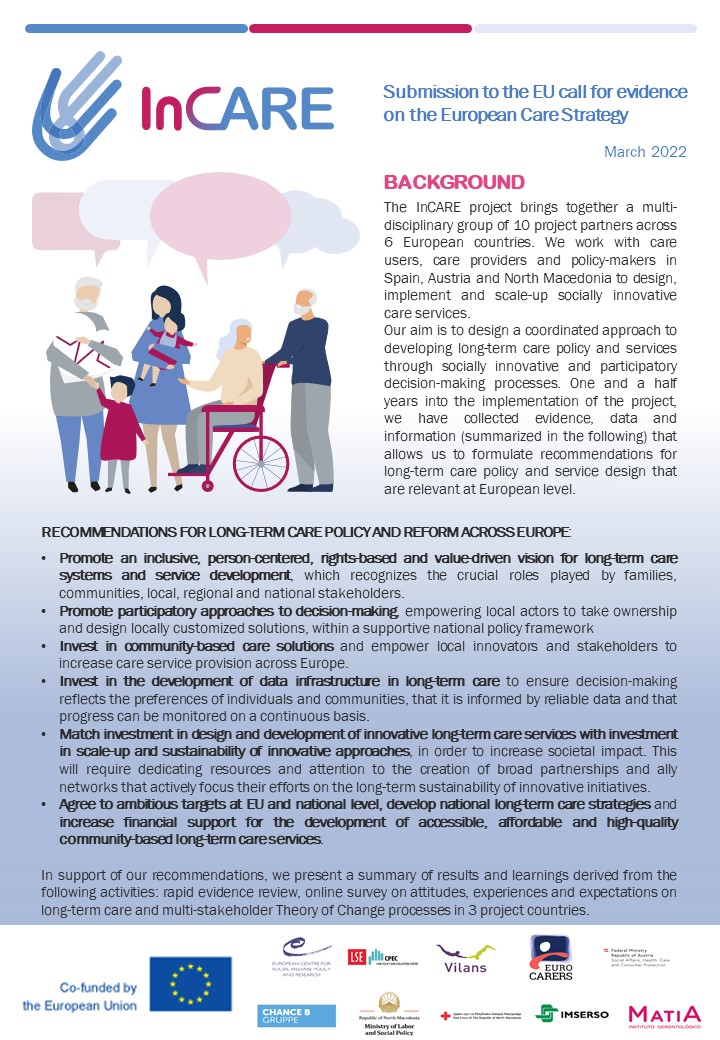
The InCARE project will contribute to the design  of a coherent and coordinated approach to the development of national long-term care policy and care services at local and regional level, by establishing socially innovative and participatory decision-making processes.

We work with care users, care provider organizations and policy-makers in Spain, Austria and North Macedonia to design, implement and scale-up innovative care services, with the ultimate goal of improving the well-being of older people and their families and increase their access to adequate and affordable care.
Start to talk openly [about] discrimination of elderly in Sweden which has been going on AT least 20 years by now [emphasis in original].

Woman, 52
Sweden

“Given the current state of care facilities, I would prefer to take care of my parents/loved ones at home and if I should require services I would prefer to be taken care of at home. The way I view care facilities in their present state is that these facilities provide everything needed to keep a person alive but greatly reduce their quality of life (e.g., loss of dignity, reduced access to meaningful activities and social interaction, loss of agency etc.). I believe it is practical, feasible and in governing bodies best interest in the long term to improve quality of care in these facilities. We now have good evidence for activities/programs that can improve wellbeing and physical health in older adults. We should be utilizing this evidence to improve the lives of older adults. If the quality of care provided in these facilities drastically improves, I would view this as the preferred option. But we are not there yet.”

Woman, 31
Canada
[translated] Additional taxation for end-of-life care is not equitable, considering that people already pay for health insurance. It would be necessary to eliminate corruption in the national health system, increase the quality of services and put a stop to the capture of the national health system by private entities who misappropriate funds that should be invested in our health, turning them into personal profit.

Woman, 37
Romania
[…] My elderly grandmother lived with my family for 25 years and she needed substantial care for the last 15 years of that. My mother was a full time carer for her and could not work. There was definitely family expectation that this would be the case. Eventually she was too frail to be at home and she lived in a nursing home for the the last 10 or so years of her life. Both of my parents mental and physical health improved substantially after that. They were still involved in visiting frequently, bringing food, doing laundry but they were also able to live their own lives. I feel very strongly that care should be provided for older people

Woman, 40
Australia
[Translated – excerpt] Long-term care is an obligation of society. The administration has to participate and set criteria for equality, but it has to get involved in management, if it wants to do so under the same conditions as everyone else. Give a choice to the citizen who chooses what he/she wants, not what the administration thinks (free choice). Care should be directed by the people, not only centred on them. Empowerment of the citizen. Promote professional training and above all competences and skills. Increase staff ratios and salaries, and above all work/family/leisure balance. There is a lot of work to be done.

Man, 55
Spain

Every person in need of care must be cared for so that he or she has all the dignity required. Taking into account their limitations, they must be provided with the highest possible quality of life. This care must be provided by family members and professional staff so that their affective and assistance needs are covered.

Woman, 64
Spain
[translate] I hope your study can contribute to helping older people in need of care.

Man, 26
Romania

As a person caring for my spouse I receive a payment from my social protection department to cover my role. This payment amounts to less than 1x€ per hour as I’m needed to be there 24 hrs per day to assist 365 days per year. I think I should receive a better benefit to do this task.

Man, 63
Ireland
[translated] My biggest fear is that I will be powerless to support and provide for myself. That would place my family in a difficult financial and physical situation, given that my future salary and pension will not be enough to cover all expenses.

Woman, 45
Republic of Moldova
[Translated] I have placed my mother in a nursing home due to advanced dementia. What is missing there are people who occupy themselves with the old people. […] Due to Corona and very limited visitation opportunities, loneliness is increasing. Thus all voluntary visiting services fall flat. […] As much as one pushes the models to accommodate old and young in shared apartments together, I found that my mother with advancing age – who loves her great-grandchildren very much – is simply more stressed when she is visited, it is too loud, too wild, etc.. So she doesn’t want to attend family gatherings anymore either. For a while she was very enthusiastic about the day care center in [redacted] – there she was offered everything she needed. Someone talked to her, they played and made music together, they prepared the snack together, etc. This combination between home and day care center would be IDEAL in my opinion.

Woman, 61
Austria
Back To Top
Translate »