skip to Main Content

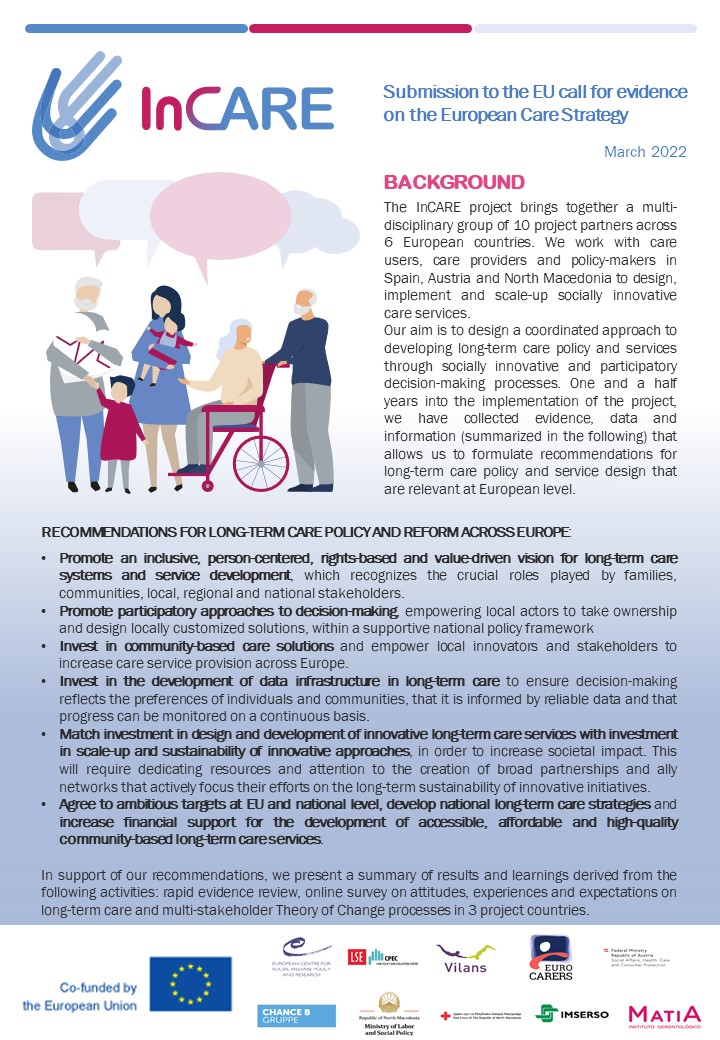
The InCARE project will contribute to the design  of a coherent and coordinated approach to the development of national long-term care policy and care services at local and regional level, by establishing socially innovative and participatory decision-making processes.

We work with care users, care provider organizations and policy-makers in Spain, Austria and North Macedonia to design, implement and scale-up innovative care services, with the ultimate goal of improving the well-being of older people and their families and increase their access to adequate and affordable care.
[Translated – excerpt] Long-term care is an obligation of society. The administration has to participate and set criteria for equality, but it has to get involved in management, if it wants to do so under the same conditions as everyone else. Give a choice to the citizen who chooses what he/she wants, not what the administration thinks (free choice). Care should be directed by the people, not only centred on them. Empowerment of the citizen. Promote professional training and above all competences and skills. Increase staff ratios and salaries, and above all work/family/leisure balance. There is a lot of work to be done.

Man, 55
Spain

“It’s very difficult to take care of elderly. It causes a lot of stress with effects on health. Wished for some more support structures. Needs have to be assessed often as they can change frequently.”

Woman, 49
Malta

Thanks for keeping this in the public eye. No easy answers, I’m not sure I agree with all of mine today, but we must keep trying!!

Man
United Kingdom
[translated] Centers for socializing of the elderly should be provided, for playing chess, knitting, and so on; because after they retire they are at home all day and have no communication with other people.

Man, 36
North Macedonia
[translated -excerpt, emphasis in original text] Home-based assistance offered by the Romanian state to older people DOES NOT EXIST. This is unacceptable. […] for sick people and the elderly the situation is extremely BAD. There is no help. No state funded services to help them at home or in an institution, facilities for the elderly are so bad they are more like prisons or labour camps. I also strongly advise you to do a study and personal visits to psychiatric hospitals, and how mental health is treated in Romania.

Woman, 39
Romania
[Translated] Children and partners should never be forced to take care of their relatives. Everyone wants to be able to live their life the way they want. It’s great that a survey like this is being done. Thank you!

Woman, 67
Austria

I have Parkinson’s Disease and I dread what the future holds for me physically and mentally.

Woman, 75
Ireland
[…] My elderly grandmother lived with my family for 25 years and she needed substantial care for the last 15 years of that. My mother was a full time carer for her and could not work. There was definitely family expectation that this would be the case. Eventually she was too frail to be at home and she lived in a nursing home for the the last 10 or so years of her life. Both of my parents mental and physical health improved substantially after that. They were still involved in visiting frequently, bringing food, doing laundry but they were also able to live their own lives. I feel very strongly that care should be provided for older people

Woman, 40
Australia

Thank you for dealing with this study as it will help many people.

Woman, 47
[translated] I am of the opinion that a pensioner has paid a rather large sum to the State month after month all his life. In old age, when that person would need long term care the state should participate in the necessary costs of the care and not leave the family to do it alone.

Woman, 40
Romania
Back To Top
Translate »