skip to Main Content

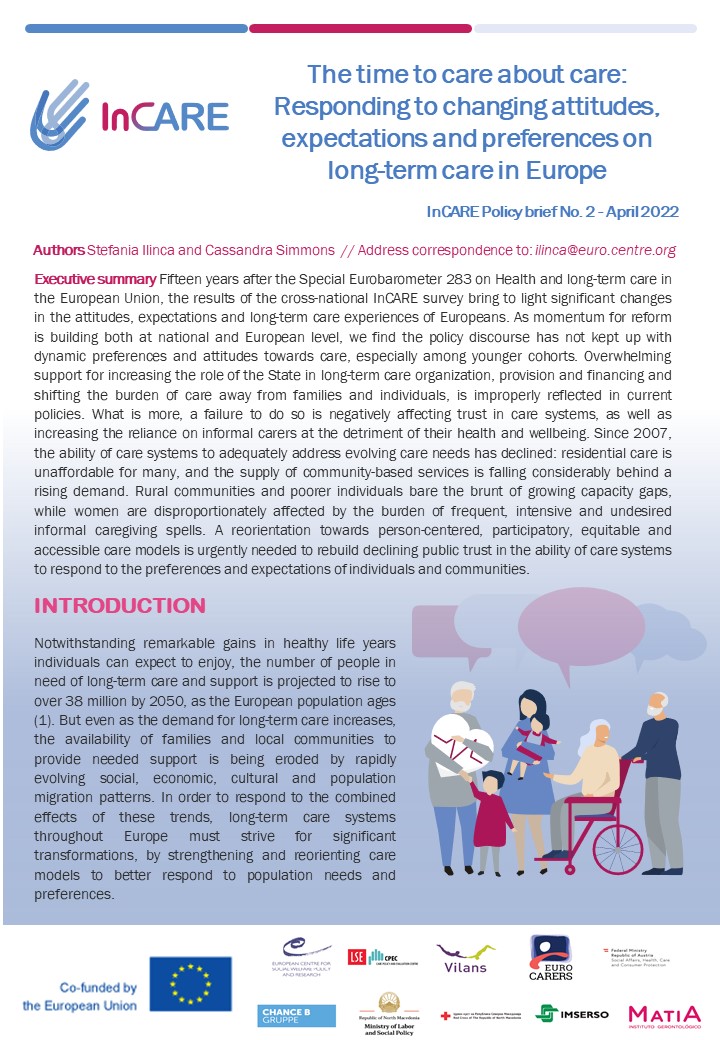
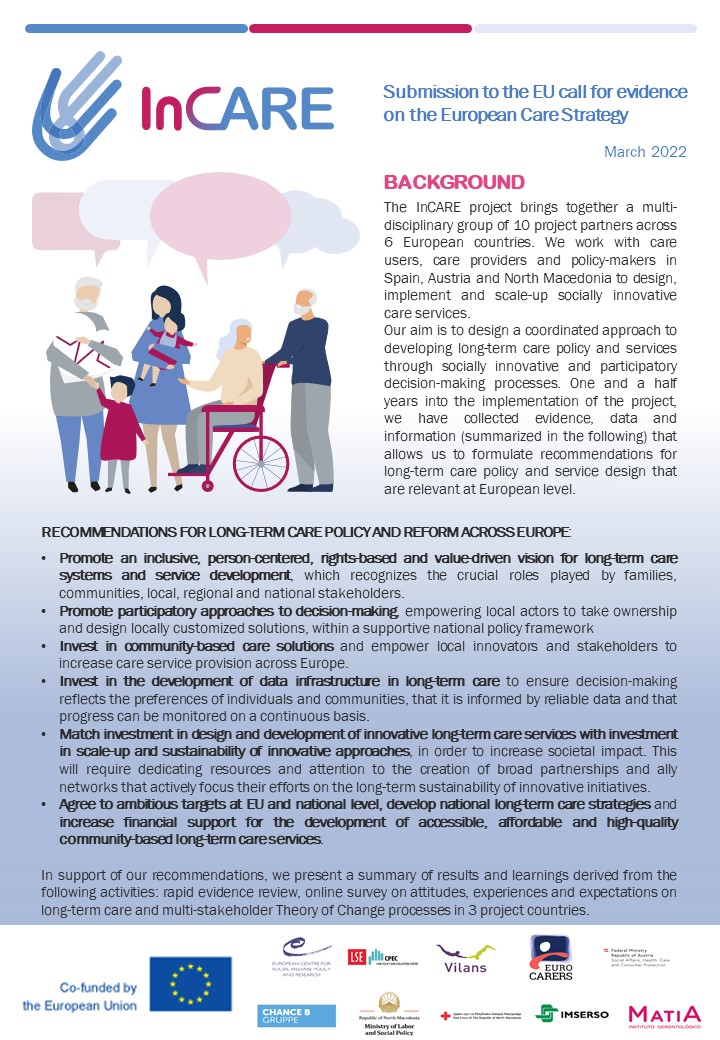
The InCARE project will contribute to the design  of a coherent and coordinated approach to the development of national long-term care policy and care services at local and regional level, by establishing socially innovative and participatory decision-making processes.

We work with care users, care provider organizations and policy-makers in Spain, Austria and North Macedonia to design, implement and scale-up innovative care services, with the ultimate goal of improving the well-being of older people and their families and increase their access to adequate and affordable care.
[Translated] I have placed my mother in a nursing home due to advanced dementia. What is missing there are people who occupy themselves with the old people. […] Due to Corona and very limited visitation opportunities, loneliness is increasing. Thus all voluntary visiting services fall flat. […] As much as one pushes the models to accommodate old and young in shared apartments together, I found that my mother with advancing age – who loves her great-grandchildren very much – is simply more stressed when she is visited, it is too loud, too wild, etc.. So she doesn’t want to attend family gatherings anymore either. For a while she was very enthusiastic about the day care center in [redacted] – there she was offered everything she needed. Someone talked to her, they played and made music together, they prepared the snack together, etc. This combination between home and day care center would be IDEAL in my opinion.

Woman, 61
Austria
[Translated] I don’t understand why people with high income and property don’t have to pay for their own place in [residential] care homes!

Woman, 74
Austria
[Translated] Do not forget to correlate loss of functional independence with disease. Do not forget that 30% of dementias can be prevented and that frailty is preventable and reversible: prevention must also be funded.

Man, 36
France
[Translated] In Belgium, we are immensely lucky that our health care system is based on solidarity. It is important that this continues and is even strengthened to avoid inequalities.

Woman, no age specified
Belgium
[translate] I hope your study can contribute to helping older people in need of care.

Man, 26
Romania
[Translated] There are now already too few caregivers and nothing is done about it! How will that be in 10 years ?!

[No gender specified], 68
Austria
[Translated] I would urgently need support as far as my parents are concerned. They live alone, my father doesn’t speak at all anymore, can’t be reached by phone either, and my mother now and then. I think they both need urgent support, but I can’t talk to them anymore. My mother had a serious brain operation, I was never informed by any doctor, by any nurse, by any social worker…….what can be done, what is available, nothing at all….

Woman, 52
Austria
[translated] You’ve made me think … I will have to come up with a plan for the future.

Woman, 58
Romania

The government should invest in training social workers, so that quality of care is as high as possible, and at the same time the social status of social workers, professional carers and nursing staff is raised, they are better paid, and young persons would like to choose such careers.

Woman, 69
Poland
[…] My elderly grandmother lived with my family for 25 years and she needed substantial care for the last 15 years of that. My mother was a full time carer for her and could not work. There was definitely family expectation that this would be the case. Eventually she was too frail to be at home and she lived in a nursing home for the the last 10 or so years of her life. Both of my parents mental and physical health improved substantially after that. They were still involved in visiting frequently, bringing food, doing laundry but they were also able to live their own lives. I feel very strongly that care should be provided for older people

Woman, 40
Australia
Back To Top
Translate »