skip to Main Content

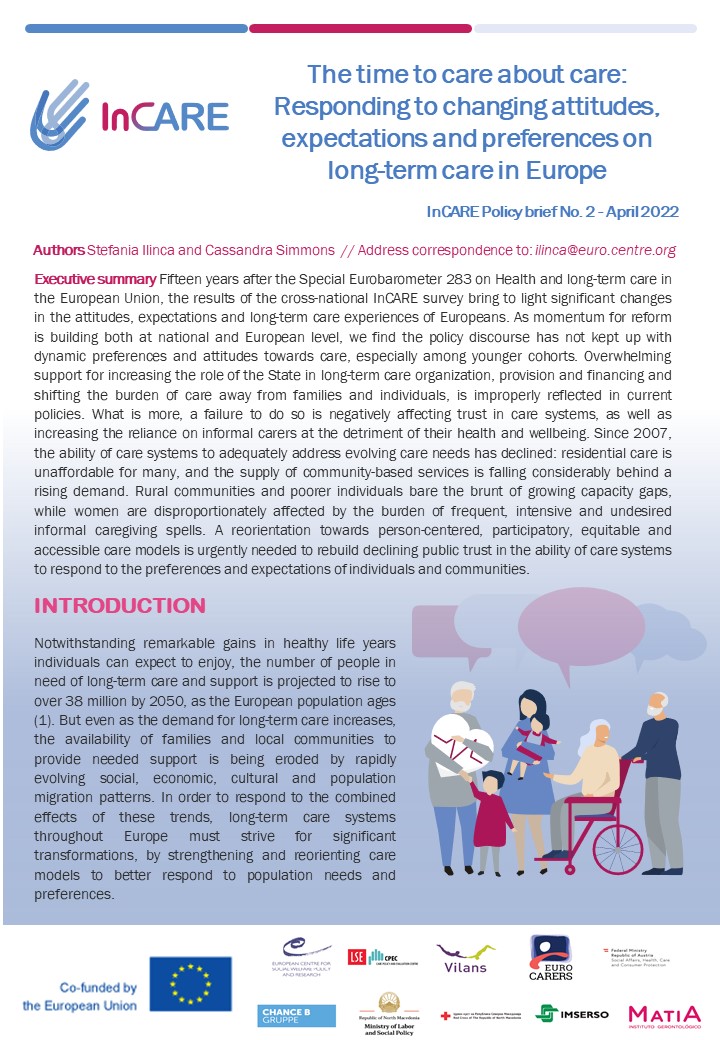
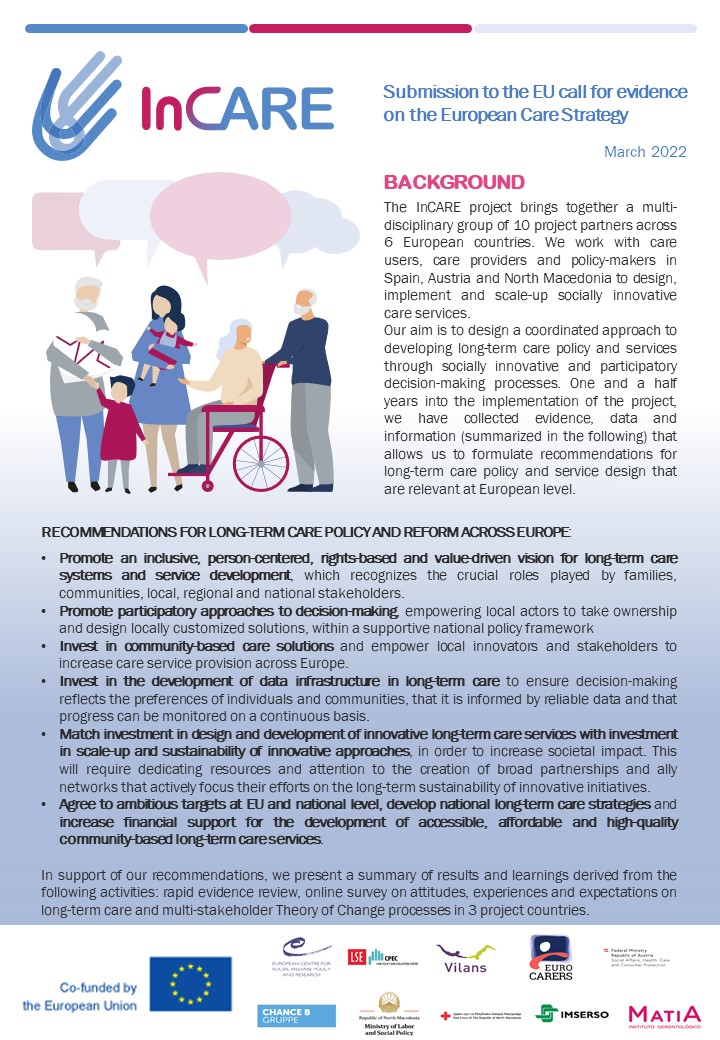
The InCARE project will contribute to the design  of a coherent and coordinated approach to the development of national long-term care policy and care services at local and regional level, by establishing socially innovative and participatory decision-making processes.

We work with care users, care provider organizations and policy-makers in Spain, Austria and North Macedonia to design, implement and scale-up innovative care services, with the ultimate goal of improving the well-being of older people and their families and increase their access to adequate and affordable care.
“Given the current state of care facilities, I would prefer to take care of my parents/loved ones at home and if I should require services I would prefer to be taken care of at home. The way I view care facilities in their present state is that these facilities provide everything needed to keep a person alive but greatly reduce their quality of life (e.g., loss of dignity, reduced access to meaningful activities and social interaction, loss of agency etc.). I believe it is practical, feasible and in governing bodies best interest in the long term to improve quality of care in these facilities. We now have good evidence for activities/programs that can improve wellbeing and physical health in older adults. We should be utilizing this evidence to improve the lives of older adults. If the quality of care provided in these facilities drastically improves, I would view this as the preferred option. But we are not there yet.”

Woman, 31
Canada
[Translated] I am not happy with the current nursing home system and it is a system that is focused on services and not on people. It is desirable that this changes with everyone’s help.

Woman, 41
Spain
[translated] Well, I hope that caregivers get a protected or priority status – I mean at work and as workers, everyone needs us, our attention, and to some extent it feels like we are omnipotent and can care for others, care for ourselves and sometimes, care for our parents. That is wrong.

Man, age not specified
North Macedonia
[Translated] It would be good if the decisions were also upheld when the care allowance is raised. Often the decision ends up in court and it is possible to challenge it. It should not be made difficult for those who are dependent on this financial support.

Woman, 36
Austria

Both my parents died in a nursing home. I believe that had there been appropriate in-home care available outside of the hours of 9am to 5pm that my mother might have been able to live at home. As it was she suffered a severe fall at night and was admitted to hospital and declined there to the point that she required full-time care. The cost of overnight carers was exorbitantly expensive. The government should put more resources into providing high quality home care which doesn’t end at 5pm when patients are most vulnerable

Woman, 44
Ireland
[Translated] I was my husband’s caregiver for 7 years. He passed away from a rare and orphaned neurodegenerative disease (PSP). When the diagnosis was announced, we felt abandoned. Then it was very difficult to find quality help even if we paid. I retired 2 years before the legal age to continue to help him. Our last and most terrible test was to have his advance directives respected. He could no longer swallow, so he could not eat or drink. He refused the gastrostomy and wanted deep sedation. I had to fight again and again to have his wishes respected. So abandoned from beginning to end!

Woman, 62
France
[translated] My biggest fear is that I will be powerless to support and provide for myself. That would place my family in a difficult financial and physical situation, given that my future salary and pension will not be enough to cover all expenses.

Woman, 45
Republic of Moldova

As a person caring for my spouse I receive a payment from my social protection department to cover my role. This payment amounts to less than 1x€ per hour as I’m needed to be there 24 hrs per day to assist 365 days per year. I think I should receive a better benefit to do this task.

Man, 63
Ireland
[Translated] I am curious about the results… It is important to increase the prestige and financial value of care at home! Explore even more possibilities for care in old age… (shared housing, generation parks and others)

Woman, 41
Austria
[…] When Covid came along it destroyed very important connections that enable older people in nursing homes to keep going & stay connected, to keep hope alive – the deterioration in my Mother in just 18 months was, & still is, devastating & resulted in her recent death. All those months we were unable to be by her side & keep her going, instead she wasted away as she was unable to comprehend what was going on with Covid, yet she was aware enough to know we were no longer with her. Looking through a window trying to communicate love & care to someone with dementia & who is very confused about why you wouldn’t come inside was one of the cruelest experiences. It was terrible to witness just how much our older people are let down by lack of creative, adequate, & in my opinion humane, care options because even in times of desperation when I considered taking my Mother out of the nursing home to live with me the pain of knowing that was not possible was very heavy as I knew the reality of what it had been like 4 years previously trying to care for her – lack of adequate home help, lack of adequate services – & now along now with significantly increased care needs it would have been a recipe for crisis. I became very unwell physically when I’d been involved in her care prior to her going to live in the nursing home.”

Woman, 46
Ireland
Back To Top
Translate »