skip to Main Content

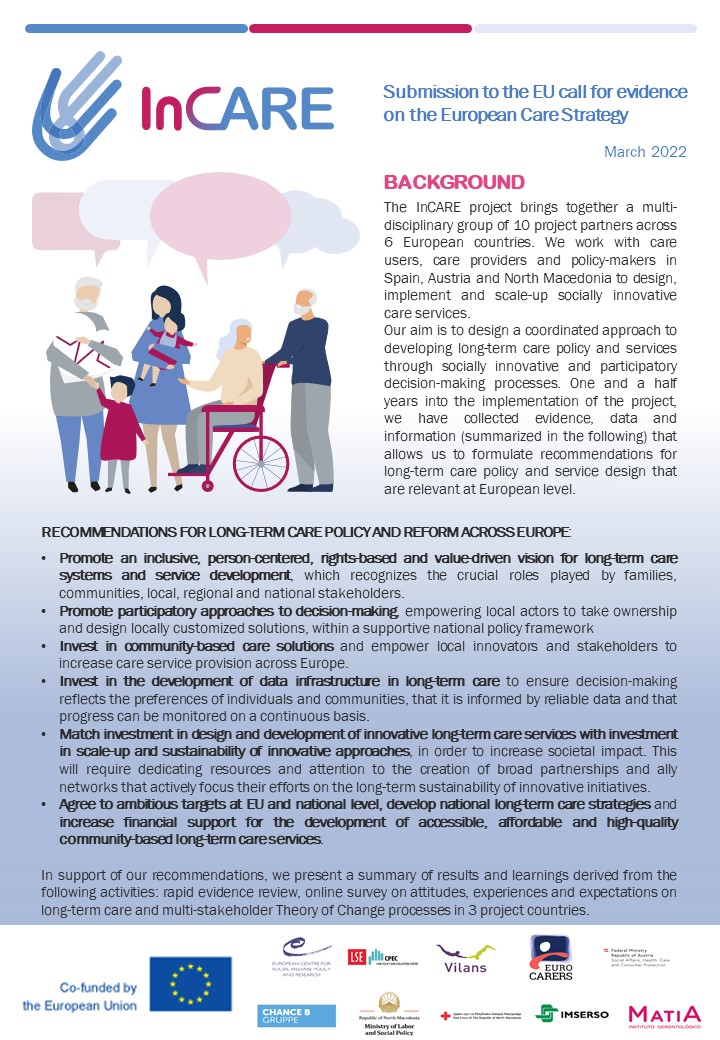
The InCARE project will contribute to the design  of a coherent and coordinated approach to the development of national long-term care policy and care services at local and regional level, by establishing socially innovative and participatory decision-making processes.

We work with care users, care provider organizations and policy-makers in Spain, Austria and North Macedonia to design, implement and scale-up innovative care services, with the ultimate goal of improving the well-being of older people and their families and increase their access to adequate and affordable care.
For the past ten years, I have been providing care to my mother with dementia and complex care needs whilst at the same time raising two children alone following the break-up of my marriage due to domestic abuse, and trying to combine this with work. I am exhausted and feel completely burnt out. Caring has negatively impacted on my work and career and affected my family life. My mother has recently moved to a small scale nursing home where she is so happy and so well looked after. There is huge pressure on families to continue to look after people with highly complex care needs and I question that. There are too few small scale nursing homes in Ireland.

Woman, 55
Ireland
[Translated] I lost my father last year (cancer). We kept him at home, with my brothers and sister, almost until the end; we are now looking after our mother. She has been in a nursing home for several months. We take turns every day to get her up, wash her, dress her, feed her and take her out. The staff at the care home is always on leave, there is a high turnover of staff. Not only does my mother pay, we each pay a small part of the accommodation, but we are the ones who take care of her from morning to night. That’s why we are part-time.

Woman, 55
France
[…] My elderly grandmother lived with my family for 25 years and she needed substantial care for the last 15 years of that. My mother was a full time carer for her and could not work. There was definitely family expectation that this would be the case. Eventually she was too frail to be at home and she lived in a nursing home for the the last 10 or so years of her life. Both of my parents mental and physical health improved substantially after that. They were still involved in visiting frequently, bringing food, doing laundry but they were also able to live their own lives. I feel very strongly that care should be provided for older people

Woman, 40
Australia

My mother could afford to pay for care but we couldn’t get consistent reliable care due to the pandemic. We chose a residence but even they are limited to what they can provide and in Canada if a higher level of care is required then the person needs to go to LTC which wasn’t available at the time and she ended up staying in hospital until she passed. The government offers home supports with a cookie cutter approach; not tailored to what would make staying in her home possible. PSWs [personal support workers] to help shower and dress but no service to wash dishes. She could shower, [but] she needed help with dinner and dishes or laundry. The maximum hours [funded by the] Government is 4 hours/week not enough to sustainably stay home.

Woman, 55
Canada
[translated] The development of home care services in Romania would contribute to increasing the quality of life of Romanians and would be of great help to family doctors [general practitioners] who are overburdened with time-consuming bureaucratic tasks.

Woman, 60
Romania
[translated] It is not easy to gain the trust of a stranger and let them take care of you. Trust and safety are also very important factors in receiving /providing long-term care.

Woman, 45
North Macedonia
[Translated] In Belgium, we are immensely lucky that our health care system is based on solidarity. It is important that this continues and is even strengthened to avoid inequalities.

Woman, no age specified
Belgium
[Translated] I don’t understand why people with high income and property don’t have to pay for their own place in [residential] care homes!

Woman, 74
Austria
[translated -excerpt, emphasis in original text] Home-based assistance offered by the Romanian state to older people DOES NOT EXIST. This is unacceptable. […] for sick people and the elderly the situation is extremely BAD. There is no help. No state funded services to help them at home or in an institution, facilities for the elderly are so bad they are more like prisons or labour camps. I also strongly advise you to do a study and personal visits to psychiatric hospitals, and how mental health is treated in Romania.

Woman, 39
Romania

Both my parents died in a nursing home. I believe that had there been appropriate in-home care available outside of the hours of 9am to 5pm that my mother might have been able to live at home. As it was she suffered a severe fall at night and was admitted to hospital and declined there to the point that she required full-time care. The cost of overnight carers was exorbitantly expensive. The government should put more resources into providing high quality home care which doesn’t end at 5pm when patients are most vulnerable

Woman, 44
Ireland
Back To Top
Translate »