
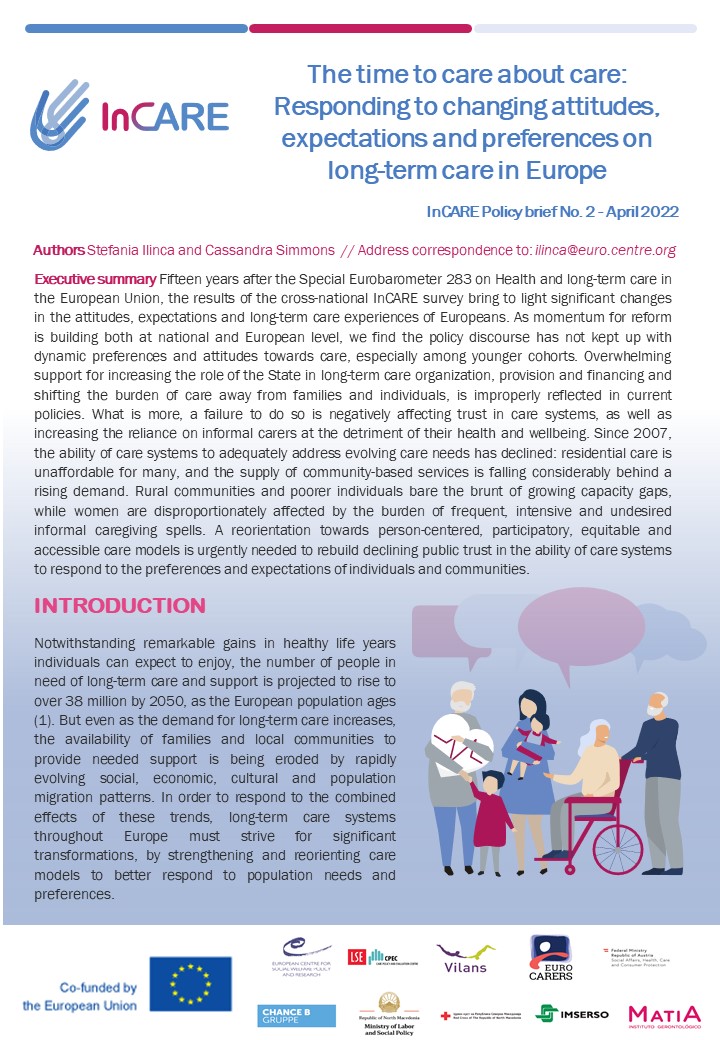
The InCARE project will contribute to the design of a coherent and coordinated approach to the development of national long-term care policy and care services at local and regional level, by establishing socially innovative and participatory decision-making processes.
We work with care users, care provider organizations and policy-makers in Spain, Austria and North Macedonia to design, implement and scale-up innovative care services, with the ultimate goal of improving the well-being of older people and their families and increase their access to adequate and affordable care.
[Translated] None of the services I have used have the means to help dependent people with multiple sclerosis. It’s a horror. I have to do everything on my own because the home carers for example can’t come if I’m in hospital or on rehabilitation…the domestic helpers are no longer available, I am not entitled to a transport service … I never qualify. I am revolted. I live alone without family and it’s really hard. I’ve been able to get help at times but it doesn’t last because the budgets are so small. Even people with severe physical disabilities don’t have adequate help. The Aviq [Agence pour une Vie de Qualité] has not been functioning for years… the situation is very serious. And it has become even worse with Covid.
Woman, 40
Belgium
[Translated] I have long cared for my sister and my mother, and now my husband who has cancer and is bedridden! I wish someone [could support me] for a few hours or once a few days so that I could go away once with my daughter and granddaughter or make a trip!
Woman, 67
Austria
[Translated] I was my husband’s caregiver for 7 years. He passed away from a rare and orphaned neurodegenerative disease (PSP). When the diagnosis was announced, we felt abandoned. Then it was very difficult to find quality help even if we paid. I retired 2 years before the legal age to continue to help him. Our last and most terrible test was to have his advance directives respected. He could no longer swallow, so he could not eat or drink. He refused the gastrostomy and wanted deep sedation. I had to fight again and again to have his wishes respected. So abandoned from beginning to end!
Woman, 62
France
[translated] My biggest fear is that I will be powerless to support and provide for myself. That would place my family in a difficult financial and physical situation, given that my future salary and pension will not be enough to cover all expenses.
Woman, 45
Republic of Moldova
[translated] These studies are interesting, but [I do not know] whether the obtained results will have an impact or be used by the competent institutions, in the direction of improving the situation with provision of care to the elderly… We have low incomes and therefore we do not have the opportunity to resign or pay for caregiver or nursing home services… nor do our parents have such pensions that can cover their expenses to stay in a nursing home, where they will live comfortably and be treated with dignity …
Woman, 53
North Macedonia
[translate] I hope your study can contribute to helping older people in need of care.
Man, 26
Romania
[translated -excerpt, emphasis in original text] Home-based assistance offered by the Romanian state to older people DOES NOT EXIST. This is unacceptable. […] for sick people and the elderly the situation is extremely BAD. There is no help. No state funded services to help them at home or in an institution, facilities for the elderly are so bad they are more like prisons or labour camps. I also strongly advise you to do a study and personal visits to psychiatric hospitals, and how mental health is treated in Romania.
Woman, 39
Romania
As a person caring for my spouse I receive a payment from my social protection department to cover my role. This payment amounts to less than 1x€ per hour as I’m needed to be there 24 hrs per day to assist 365 days per year. I think I should receive a better benefit to do this task.
Man, 63
Ireland
[translated -excerpt] I would like to see society organise a systemic way of funding care for older people in their own homes for as long as possible, and then in institutions when they need it. Funding should be provided through long-term contributions to an individual’s fund, as for a pension, or through insurance. The problem of paying for care for the elderly is a major problem, and the hardship and burden on the person being cared for and on those close to them is great.
Man, 63
Slovenia
Start to talk openly [about] discrimination of elderly in Sweden which has been going on AT least 20 years by now [emphasis in original].
Woman, 52
Sweden