skip to Main Content

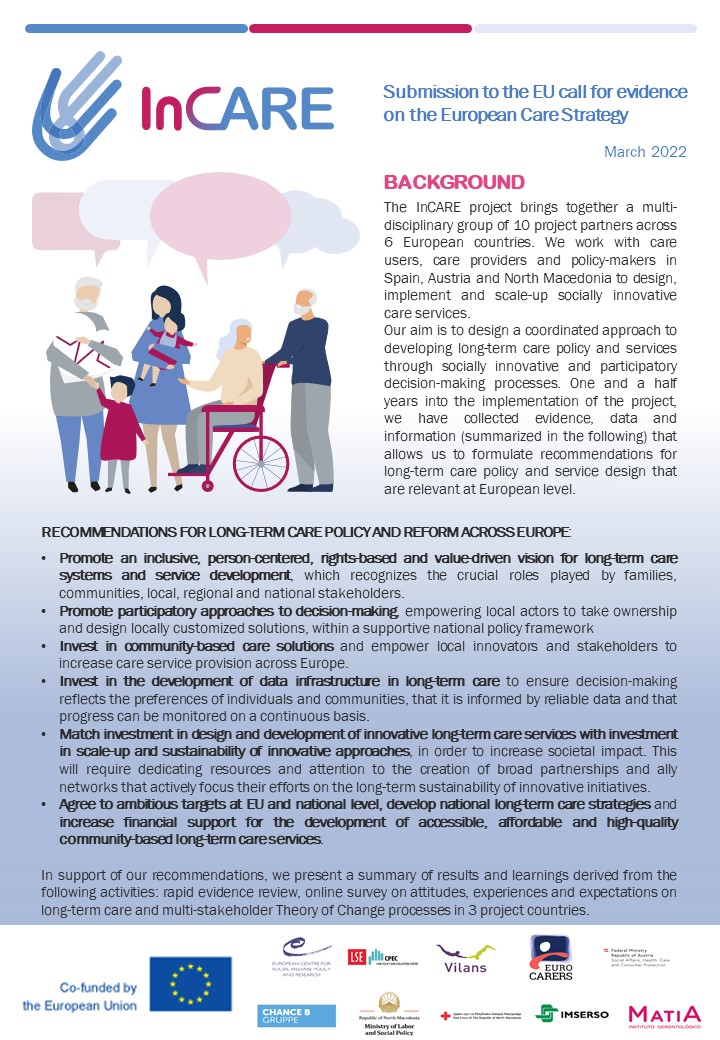
The InCARE project will contribute to the design  of a coherent and coordinated approach to the development of national long-term care policy and care services at local and regional level, by establishing socially innovative and participatory decision-making processes.

We work with care users, care provider organizations and policy-makers in Spain, Austria and North Macedonia to design, implement and scale-up innovative care services, with the ultimate goal of improving the well-being of older people and their families and increase their access to adequate and affordable care.
“Given the current state of care facilities, I would prefer to take care of my parents/loved ones at home and if I should require services I would prefer to be taken care of at home. The way I view care facilities in their present state is that these facilities provide everything needed to keep a person alive but greatly reduce their quality of life (e.g., loss of dignity, reduced access to meaningful activities and social interaction, loss of agency etc.). I believe it is practical, feasible and in governing bodies best interest in the long term to improve quality of care in these facilities. We now have good evidence for activities/programs that can improve wellbeing and physical health in older adults. We should be utilizing this evidence to improve the lives of older adults. If the quality of care provided in these facilities drastically improves, I would view this as the preferred option. But we are not there yet.”

Woman, 31
Canada
[Translated] In Belgium, we are immensely lucky that our health care system is based on solidarity. It is important that this continues and is even strengthened to avoid inequalities.

Woman, no age specified
Belgium
[Translated] It is complicated to get help when the parent who needs it is living abroad (France) and it is impossible for him/her to live alone. Because no retirement home can be found for him/her, the only solution is to take him/her at home (in another country of the European Union)

Woman, 63
Belgium
[translated -excerpt, emphasis in original text] Home-based assistance offered by the Romanian state to older people DOES NOT EXIST. This is unacceptable. […] for sick people and the elderly the situation is extremely BAD. There is no help. No state funded services to help them at home or in an institution, facilities for the elderly are so bad they are more like prisons or labour camps. I also strongly advise you to do a study and personal visits to psychiatric hospitals, and how mental health is treated in Romania.

Woman, 39
Romania
[translated] You’ve made me think … I will have to come up with a plan for the future.

Woman, 58
Romania
[Translated] Support and training for family caregivers is needed in many ways.

Woman, 66
Austria
[translated] Let’s not abandon the elderly, they do not deserve that.

Woman, 61
North Macedonia
[Translated] Children and partners should never be forced to take care of their relatives. Everyone wants to be able to live their life the way they want. It’s great that a survey like this is being done. Thank you!

Woman, 67
Austria
[translated] Well, I hope that caregivers get a protected or priority status – I mean at work and as workers, everyone needs us, our attention, and to some extent it feels like we are omnipotent and can care for others, care for ourselves and sometimes, care for our parents. That is wrong.

Man, age not specified
North Macedonia
[Translated] I would like such surveys to be more efficient and to have more participation in them, and consequently I would like to talk and learn more about these issues in order to take action and make life easier for many individuals.

Woman, 22
Albania
Back To Top
Translate »