skip to Main Content

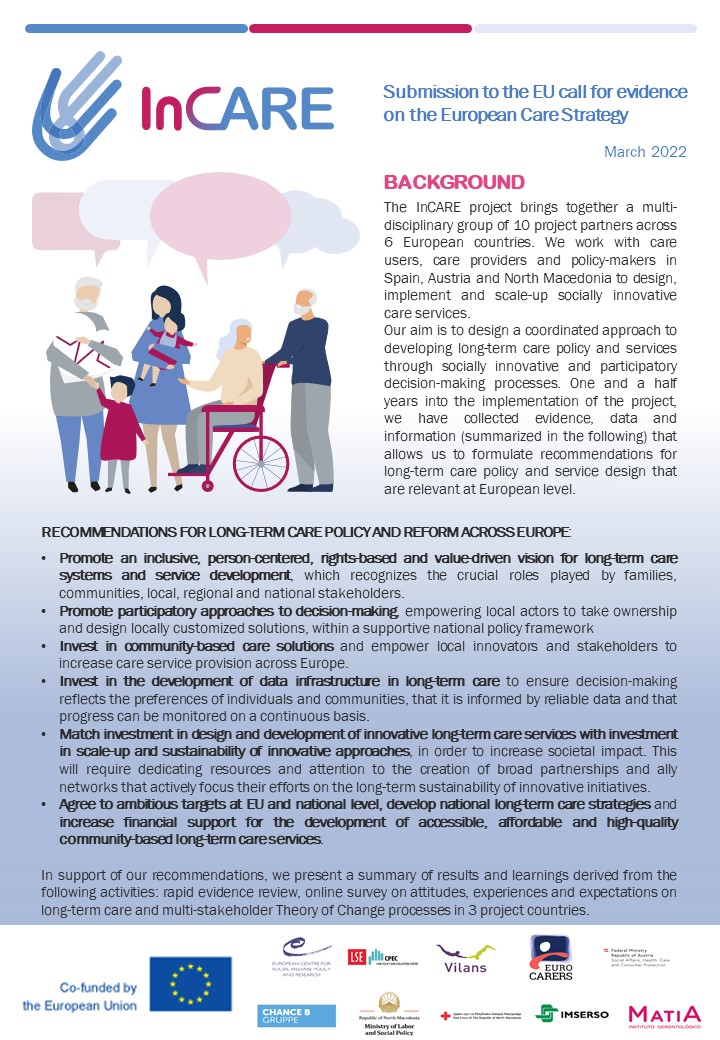
The InCARE project will contribute to the design  of a coherent and coordinated approach to the development of national long-term care policy and care services at local and regional level, by establishing socially innovative and participatory decision-making processes.

We work with care users, care provider organizations and policy-makers in Spain, Austria and North Macedonia to design, implement and scale-up innovative care services, with the ultimate goal of improving the well-being of older people and their families and increase their access to adequate and affordable care.
[translated] Well, I hope that caregivers get a protected or priority status – I mean at work and as workers, everyone needs us, our attention, and to some extent it feels like we are omnipotent and can care for others, care for ourselves and sometimes, care for our parents. That is wrong.

Man, age not specified
North Macedonia
[translated -excerpt, emphasis in original text] Home-based assistance offered by the Romanian state to older people DOES NOT EXIST. This is unacceptable. […] for sick people and the elderly the situation is extremely BAD. There is no help. No state funded services to help them at home or in an institution, facilities for the elderly are so bad they are more like prisons or labour camps. I also strongly advise you to do a study and personal visits to psychiatric hospitals, and how mental health is treated in Romania.

Woman, 39
Romania

The government should invest in training social workers, so that quality of care is as high as possible, and at the same time the social status of social workers, professional carers and nursing staff is raised, they are better paid, and young persons would like to choose such careers.

Woman, 69
Poland
[translated -excerpt] I would like to see society organise a systemic way of funding care for older people in their own homes for as long as possible, and then in institutions when they need it. Funding should be provided through long-term contributions to an individual’s fund, as for a pension, or through insurance. The problem of paying for care for the elderly is a major problem, and the hardship and burden on the person being cared for and on those close to them is great.

Man, 63
Slovenia
[translated] Let’s not abandon the elderly, they do not deserve that.

Woman, 61
North Macedonia
[Translated] I would like such surveys to be more efficient and to have more participation in them, and consequently I would like to talk and learn more about these issues in order to take action and make life easier for many individuals.

Woman, 22
Albania
[Translated] I lost my father last year (cancer). We kept him at home, with my brothers and sister, almost until the end; we are now looking after our mother. She has been in a nursing home for several months. We take turns every day to get her up, wash her, dress her, feed her and take her out. The staff at the care home is always on leave, there is a high turnover of staff. Not only does my mother pay, we each pay a small part of the accommodation, but we are the ones who take care of her from morning to night. That’s why we are part-time.

Woman, 55
France

Start to talk openly [about] discrimination of elderly in Sweden which has been going on AT least 20 years by now [emphasis in original].

Woman, 52
Sweden
[Translated] I have long cared for my sister and my mother, and now my husband who has cancer and is bedridden! I wish someone [could support me] for a few hours or once a few days so that I could go away once with my daughter and granddaughter or make a trip!

Woman, 67
Austria
[translated] My biggest fear is that I will be powerless to support and provide for myself. That would place my family in a difficult financial and physical situation, given that my future salary and pension will not be enough to cover all expenses.

Woman, 45
Republic of Moldova
Back To Top
Translate »