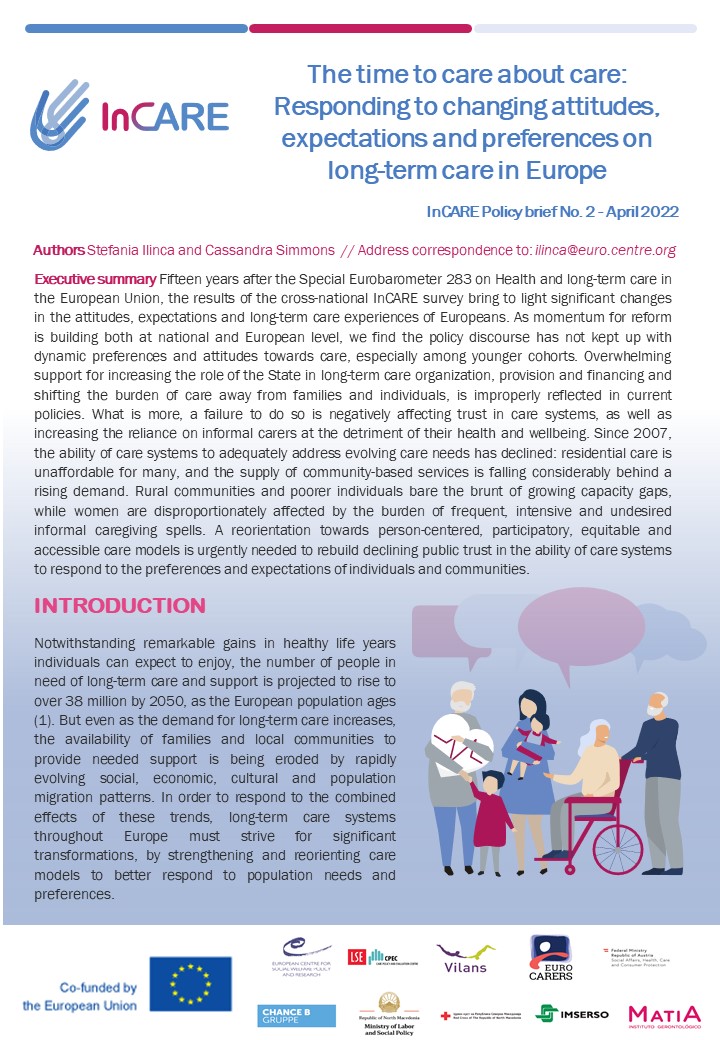
The InCARE project will contribute to the design of a coherent and coordinated approach to the development of national long-term care policy and care services at local and regional level, by establishing socially innovative and participatory decision-making processes.
We work with care users, care provider organizations and policy-makers in Spain, Austria and North Macedonia to design, implement and scale-up innovative care services, with the ultimate goal of improving the well-being of older people and their families and increase their access to adequate and affordable care.
[translated] Centers for socializing of the elderly should be provided, for playing chess, knitting, and so on; because after they retire they are at home all day and have no communication with other people.
Man, 36
North Macedonia
[translated] Additional taxation for end-of-life care is not equitable, considering that people already pay for health insurance. It would be necessary to eliminate corruption in the national health system, increase the quality of services and put a stop to the capture of the national health system by private entities who misappropriate funds that should be invested in our health, turning them into personal profit.
Woman, 37
Romania
[Translated] In Belgium, we are immensely lucky that our health care system is based on solidarity. It is important that this continues and is even strengthened to avoid inequalities.
Woman, no age specified
Belgium
[translated] Long-term care should be almost exclusively the prerogative of state institutions that should have the necessary infrastructure and resources to respond to the needs of older people and their families.
Man, 47
Romania
[Translated] It is complicated to get help when the parent who needs it is living abroad (France) and it is impossible for him/her to live alone. Because no retirement home can be found for him/her, the only solution is to take him/her at home (in another country of the European Union)
Woman, 63
Belgium
[Translated] I lost my father last year (cancer). We kept him at home, with my brothers and sister, almost until the end; we are now looking after our mother. She has been in a nursing home for several months. We take turns every day to get her up, wash her, dress her, feed her and take her out. The staff at the care home is always on leave, there is a high turnover of staff. Not only does my mother pay, we each pay a small part of the accommodation, but we are the ones who take care of her from morning to night. That’s why we are part-time.
Woman, 55
France
[translated] This issue [of long-term care] needs to be discussed and prioritised by the state, because the population is ageing, children are going abroad and local structures for [supporting older people] need to be improved and a concrete annual budget established. We will all reach an age when we need help.
Woman, 43
Republic of Moldova
[…] When Covid came along it destroyed very important connections that enable older people in nursing homes to keep going & stay connected, to keep hope alive – the deterioration in my Mother in just 18 months was, & still is, devastating & resulted in her recent death. All those months we were unable to be by her side & keep her going, instead she wasted away as she was unable to comprehend what was going on with Covid, yet she was aware enough to know we were no longer with her. Looking through a window trying to communicate love & care to someone with dementia & who is very confused about why you wouldn’t come inside was one of the cruelest experiences. It was terrible to witness just how much our older people are let down by lack of creative, adequate, & in my opinion humane, care options because even in times of desperation when I considered taking my Mother out of the nursing home to live with me the pain of knowing that was not possible was very heavy as I knew the reality of what it had been like 4 years previously trying to care for her – lack of adequate home help, lack of adequate services – & now along now with significantly increased care needs it would have been a recipe for crisis. I became very unwell physically when I’d been involved in her care prior to her going to live in the nursing home.”
Woman, 46
Ireland
Thank you for dealing with this study as it will help many people.
Woman, 47
[Translated] I was my husband’s caregiver for 7 years. He passed away from a rare and orphaned neurodegenerative disease (PSP). When the diagnosis was announced, we felt abandoned. Then it was very difficult to find quality help even if we paid. I retired 2 years before the legal age to continue to help him. Our last and most terrible test was to have his advance directives respected. He could no longer swallow, so he could not eat or drink. He refused the gastrostomy and wanted deep sedation. I had to fight again and again to have his wishes respected. So abandoned from beginning to end!
Woman, 62
France