skip to Main Content

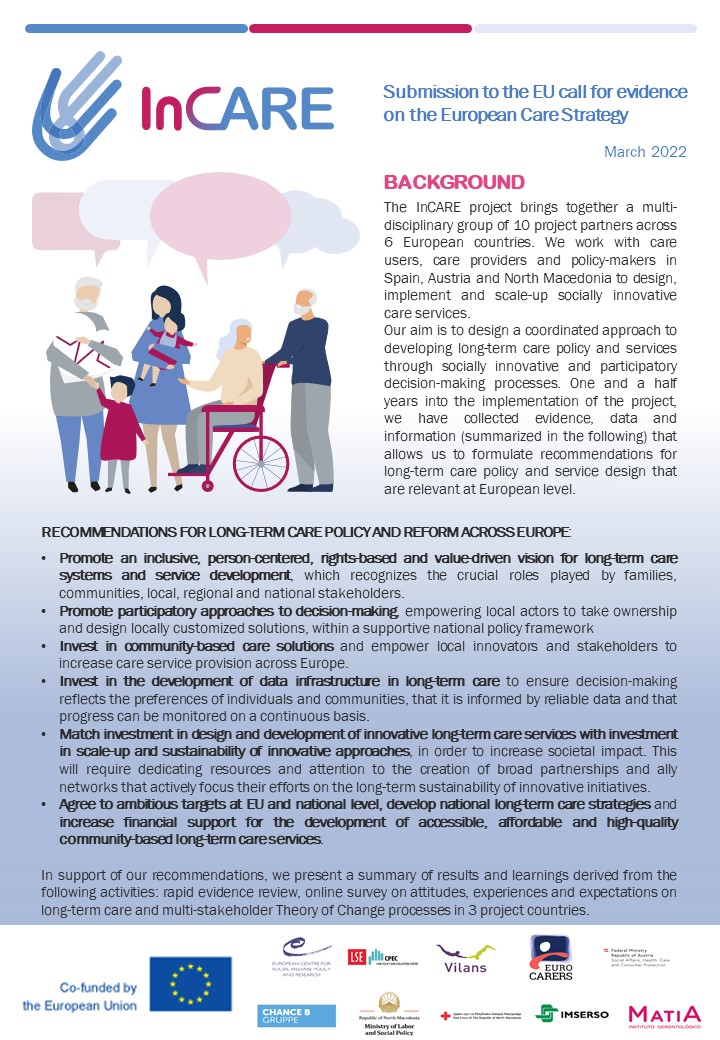
The InCARE project will contribute to the design  of a coherent and coordinated approach to the development of national long-term care policy and care services at local and regional level, by establishing socially innovative and participatory decision-making processes.

We work with care users, care provider organizations and policy-makers in Spain, Austria and North Macedonia to design, implement and scale-up innovative care services, with the ultimate goal of improving the well-being of older people and their families and increase their access to adequate and affordable care.
I visit my stepmother who is in a wheelchair after a severe stroke 14 years ago. She can cope with the costs of care so I can see the restrictions she faces even when there is sufficient money. She is physically but not mentally disabled. She is unable to use a smart phone or an I-pad and needs 24 [hour] help. She cannot use even disabled toilets. Access into taxis is difficult and impossible in a private car.

Woman, 74
United Kingdom
[Translated] I am curious about the results… It is important to increase the prestige and financial value of care at home! Explore even more possibilities for care in old age… (shared housing, generation parks and others)

Woman, 41
Austria
[translated] Long-term care should be almost exclusively the prerogative of state institutions that should have the necessary infrastructure and resources to respond to the needs of older people and their families.

Man, 47
Romania
[translated] There is a need to develop care services in the country, especially home (community-based) care as well as mental health, rehabilitation and recovery, and palliative care services.

Woman, 38
Republic of Moldova
[Translated] I would not want my future to be in the hands of politicians but in the hands of qualified experts.

Man
Spain

The government should invest in training social workers, so that quality of care is as high as possible, and at the same time the social status of social workers, professional carers and nursing staff is raised, they are better paid, and young persons would like to choose such careers.

Woman, 69
Poland
[Translated] In the next few years, Germany will need more good care facilities, if possible connected with other living facilities in which partners can also live. With high quality standards, but also with empathetic nursing and care staff and good living standards. With medical care, physiotherapy and a good activation program. Care should be affordable for all and not be passed on to family members who risk their health, private life and income for it. Nursing home care should not be stigmatized, as it relieves relatives of a great deal of work and ensures care free interaction with the persons to be cared for. Financial reasons should not be the reason why people do not go to a nursing home, because the psychological burden is too high.

Woman, 66
Germany
[translated] I would gladly take care of my family members if there were not serious issues that put a big barrier between me and them. It’s easy to place the responsibility on the shoulders of family members when one needs support, but no one considers that the one who is supposed to be the caregiver may be rejected from this role. It is a particular situation, but unfortunately not unique.

Woman, 52
Romania
[Translated] There are now already too few caregivers and nothing is done about it! How will that be in 10 years ?!

[No gender specified], 68
Austria
[Translated] I was my husband’s caregiver for 7 years. He passed away from a rare and orphaned neurodegenerative disease (PSP). When the diagnosis was announced, we felt abandoned. Then it was very difficult to find quality help even if we paid. I retired 2 years before the legal age to continue to help him. Our last and most terrible test was to have his advance directives respected. He could no longer swallow, so he could not eat or drink. He refused the gastrostomy and wanted deep sedation. I had to fight again and again to have his wishes respected. So abandoned from beginning to end!

Woman, 62
France
Back To Top
Translate »