skip to Main Content

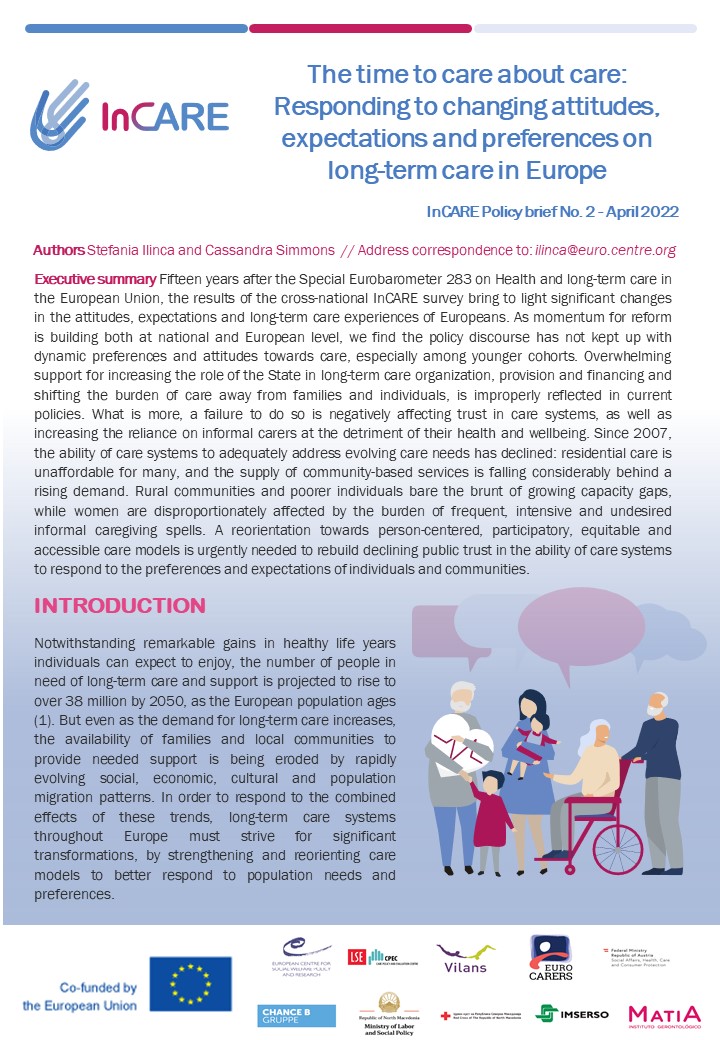
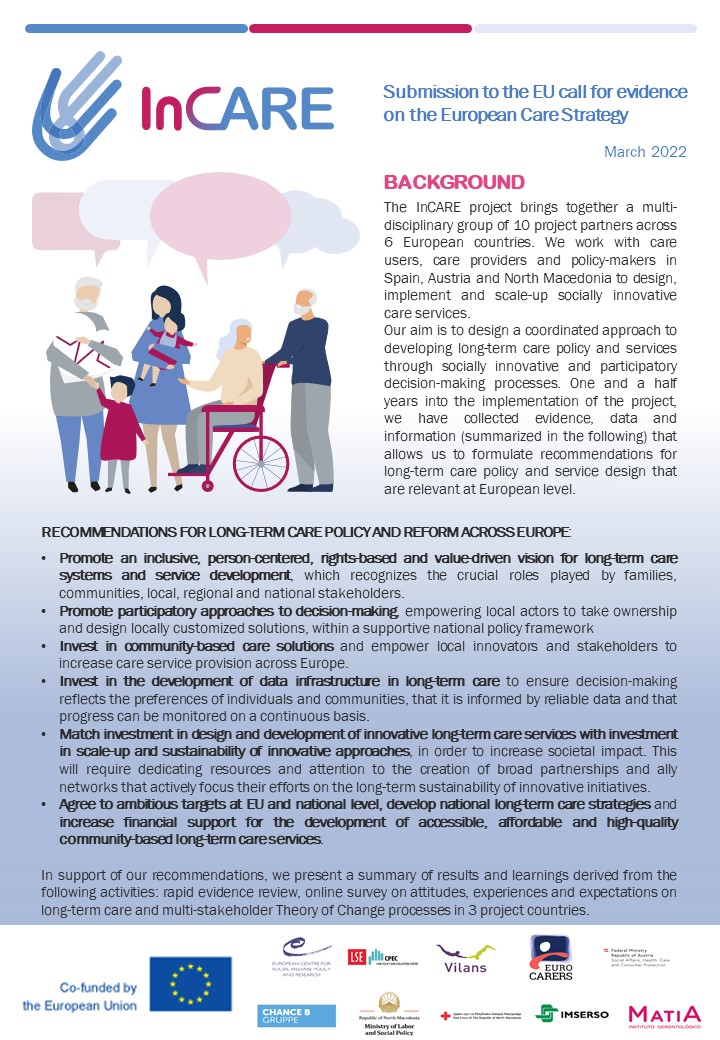
The InCARE project will contribute to the design  of a coherent and coordinated approach to the development of national long-term care policy and care services at local and regional level, by establishing socially innovative and participatory decision-making processes.

We work with care users, care provider organizations and policy-makers in Spain, Austria and North Macedonia to design, implement and scale-up innovative care services, with the ultimate goal of improving the well-being of older people and their families and increase their access to adequate and affordable care.
My mother could afford to pay for care but we couldn’t get consistent reliable care due to the pandemic. We chose a residence but even they are limited to what they can provide and in Canada if a higher level of care is required then the person needs to go to LTC which wasn’t available at the time and she ended up staying in hospital until she passed. The government offers home supports with a cookie cutter approach; not tailored to what would make staying in her home possible. PSWs [personal support workers] to help shower and dress but no service to wash dishes. She could shower, [but] she needed help with dinner and dishes or laundry. The maximum hours [funded by the] Government is 4 hours/week not enough to sustainably stay home.

Woman, 55
Canada
[Translated] Support and training for family caregivers is needed in many ways.

Woman, 66
Austria
[Translated] It would be good if the decisions were also upheld when the care allowance is raised. Often the decision ends up in court and it is possible to challenge it. It should not be made difficult for those who are dependent on this financial support.

Woman, 36
Austria
[Translated] Do not forget to correlate loss of functional independence with disease. Do not forget that 30% of dementias can be prevented and that frailty is preventable and reversible: prevention must also be funded.

Man, 36
France

I have Parkinson’s Disease and I dread what the future holds for me physically and mentally.

Woman, 75
Ireland

As a person caring for my spouse I receive a payment from my social protection department to cover my role. This payment amounts to less than 1x€ per hour as I’m needed to be there 24 hrs per day to assist 365 days per year. I think I should receive a better benefit to do this task.

Man, 63
Ireland
[translated] I would gladly take care of my family members if there were not serious issues that put a big barrier between me and them. It’s easy to place the responsibility on the shoulders of family members when one needs support, but no one considers that the one who is supposed to be the caregiver may be rejected from this role. It is a particular situation, but unfortunately not unique.

Woman, 52
Romania
[translated] In general, the state should take care of the financing of care services and introduce a system for quick access to emergency medical care.

Woman, 72
North Macedonia
[Translated] I would like such surveys to be more efficient and to have more participation in them, and consequently I would like to talk and learn more about these issues in order to take action and make life easier for many individuals.

Woman, 22
Albania

For the past ten years, I have been providing care to my mother with dementia and complex care needs whilst at the same time raising two children alone following the break-up of my marriage due to domestic abuse, and trying to combine this with work. I am exhausted and feel completely burnt out. Caring has negatively impacted on my work and career and affected my family life. My mother has recently moved to a small scale nursing home where she is so happy and so well looked after. There is huge pressure on families to continue to look after people with highly complex care needs and I question that. There are too few small scale nursing homes in Ireland.

Woman, 55
Ireland
Back To Top
Translate »