skip to Main Content

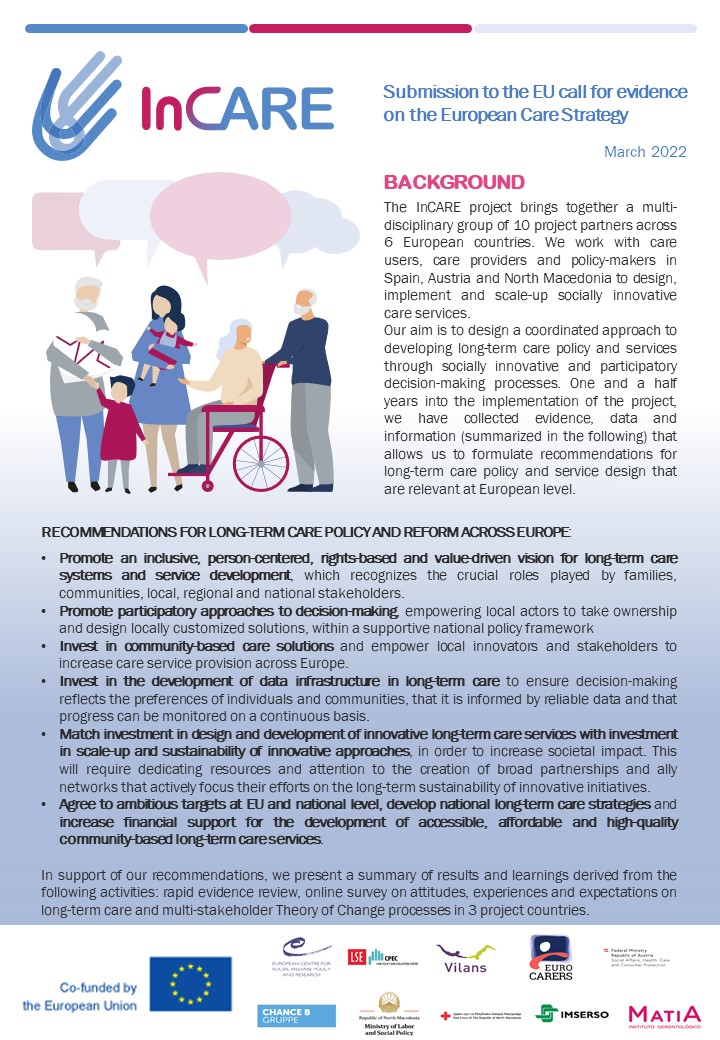
The InCARE project will contribute to the design  of a coherent and coordinated approach to the development of national long-term care policy and care services at local and regional level, by establishing socially innovative and participatory decision-making processes.

We work with care users, care provider organizations and policy-makers in Spain, Austria and North Macedonia to design, implement and scale-up innovative care services, with the ultimate goal of improving the well-being of older people and their families and increase their access to adequate and affordable care.
[translated -excerpt] I would like to see society organise a systemic way of funding care for older people in their own homes for as long as possible, and then in institutions when they need it. Funding should be provided through long-term contributions to an individual’s fund, as for a pension, or through insurance. The problem of paying for care for the elderly is a major problem, and the hardship and burden on the person being cared for and on those close to them is great.

Man, 63
Slovenia
[translated] It is not easy to gain the trust of a stranger and let them take care of you. Trust and safety are also very important factors in receiving /providing long-term care.

Woman, 45
North Macedonia

“Given the current state of care facilities, I would prefer to take care of my parents/loved ones at home and if I should require services I would prefer to be taken care of at home. The way I view care facilities in their present state is that these facilities provide everything needed to keep a person alive but greatly reduce their quality of life (e.g., loss of dignity, reduced access to meaningful activities and social interaction, loss of agency etc.). I believe it is practical, feasible and in governing bodies best interest in the long term to improve quality of care in these facilities. We now have good evidence for activities/programs that can improve wellbeing and physical health in older adults. We should be utilizing this evidence to improve the lives of older adults. If the quality of care provided in these facilities drastically improves, I would view this as the preferred option. But we are not there yet.”

Woman, 31
Canada
[Translated] There are now already too few caregivers and nothing is done about it! How will that be in 10 years ?!

[No gender specified], 68
Austria

I have Parkinson’s Disease and I dread what the future holds for me physically and mentally.

Woman, 75
Ireland
[translate] I hope your study can contribute to helping older people in need of care.

Man, 26
Romania
[translated] My biggest fear is that I will be powerless to support and provide for myself. That would place my family in a difficult financial and physical situation, given that my future salary and pension will not be enough to cover all expenses.

Woman, 45
Republic of Moldova
[translated] In general, the state should take care of the financing of care services and introduce a system for quick access to emergency medical care.

Woman, 72
North Macedonia
[Translated] I am curious about the results… It is important to increase the prestige and financial value of care at home! Explore even more possibilities for care in old age… (shared housing, generation parks and others)

Woman, 41
Austria

Thanks for keeping this in the public eye. No easy answers, I’m not sure I agree with all of mine today, but we must keep trying!!

Man
United Kingdom
Back To Top
Translate »