skip to Main Content

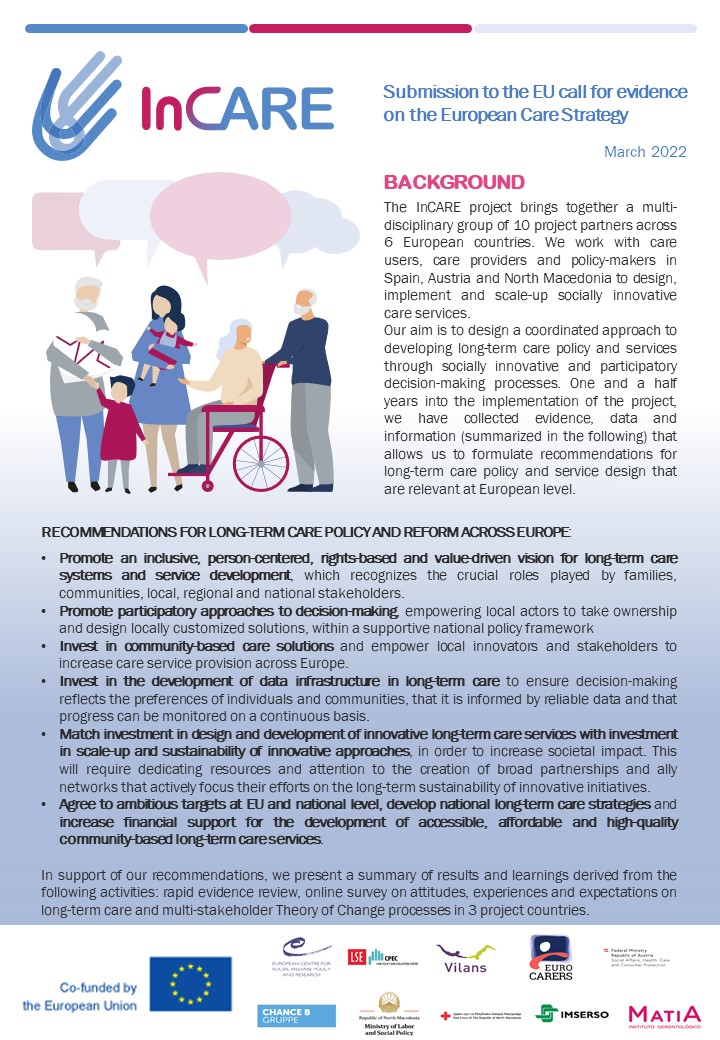
The InCARE project will contribute to the design  of a coherent and coordinated approach to the development of national long-term care policy and care services at local and regional level, by establishing socially innovative and participatory decision-making processes.

We work with care users, care provider organizations and policy-makers in Spain, Austria and North Macedonia to design, implement and scale-up innovative care services, with the ultimate goal of improving the well-being of older people and their families and increase their access to adequate and affordable care.
[Translated] It is complicated to get help when the parent who needs it is living abroad (France) and it is impossible for him/her to live alone. Because no retirement home can be found for him/her, the only solution is to take him/her at home (in another country of the European Union)

Woman, 63
Belgium
[Translated] In the next few years, Germany will need more good care facilities, if possible connected with other living facilities in which partners can also live. With high quality standards, but also with empathetic nursing and care staff and good living standards. With medical care, physiotherapy and a good activation program. Care should be affordable for all and not be passed on to family members who risk their health, private life and income for it. Nursing home care should not be stigmatized, as it relieves relatives of a great deal of work and ensures care free interaction with the persons to be cared for. Financial reasons should not be the reason why people do not go to a nursing home, because the psychological burden is too high.

Woman, 66
Germany
[translated] Let’s not abandon the elderly, they do not deserve that.

Woman, 61
North Macedonia
[Translated] None of the services I have used have the means to help dependent people with multiple sclerosis. It’s a horror. I have to do everything on my own because the home carers for example can’t come if I’m in hospital or on rehabilitation…the domestic helpers are no longer available, I am not entitled to a transport service … I never qualify. I am revolted. I live alone without family and it’s really hard. I’ve been able to get help at times but it doesn’t last because the budgets are so small. Even people with severe physical disabilities don’t have adequate help. The Aviq [Agence pour une Vie de Qualité] has not been functioning for years… the situation is very serious. And it has become even worse with Covid.

Woman, 40
Belgium
[translated] This issue [of long-term care] needs to be discussed and prioritised by the state, because the population is ageing, children are going abroad and local structures for [supporting older people] need to be improved and a concrete annual budget established. We will all reach an age when we need help.

Woman, 43
Republic of Moldova

As a person caring for my spouse I receive a payment from my social protection department to cover my role. This payment amounts to less than 1x€ per hour as I’m needed to be there 24 hrs per day to assist 365 days per year. I think I should receive a better benefit to do this task.

Man, 63
Ireland

The government should invest in training social workers, so that quality of care is as high as possible, and at the same time the social status of social workers, professional carers and nursing staff is raised, they are better paid, and young persons would like to choose such careers.

Woman, 69
Poland
[Translated] I care for my husband after a stroke and brain hemorrhage, which means he needs me around the clock. I would like to have a paid time off of one week once a year and my husband is well taken care of and does not feel “deported”. After all, by taking care of him, I save the state a lot of money!

Woman, 72
Austria
[Translated] I would not want my future to be in the hands of politicians but in the hands of qualified experts.

Man
Spain
[Translated] Support and training for family caregivers is needed in many ways.

Woman, 66
Austria
Back To Top
Translate »